What the thing is
Tagine is a Moroccan stew named after its earthenware cooking vessel.
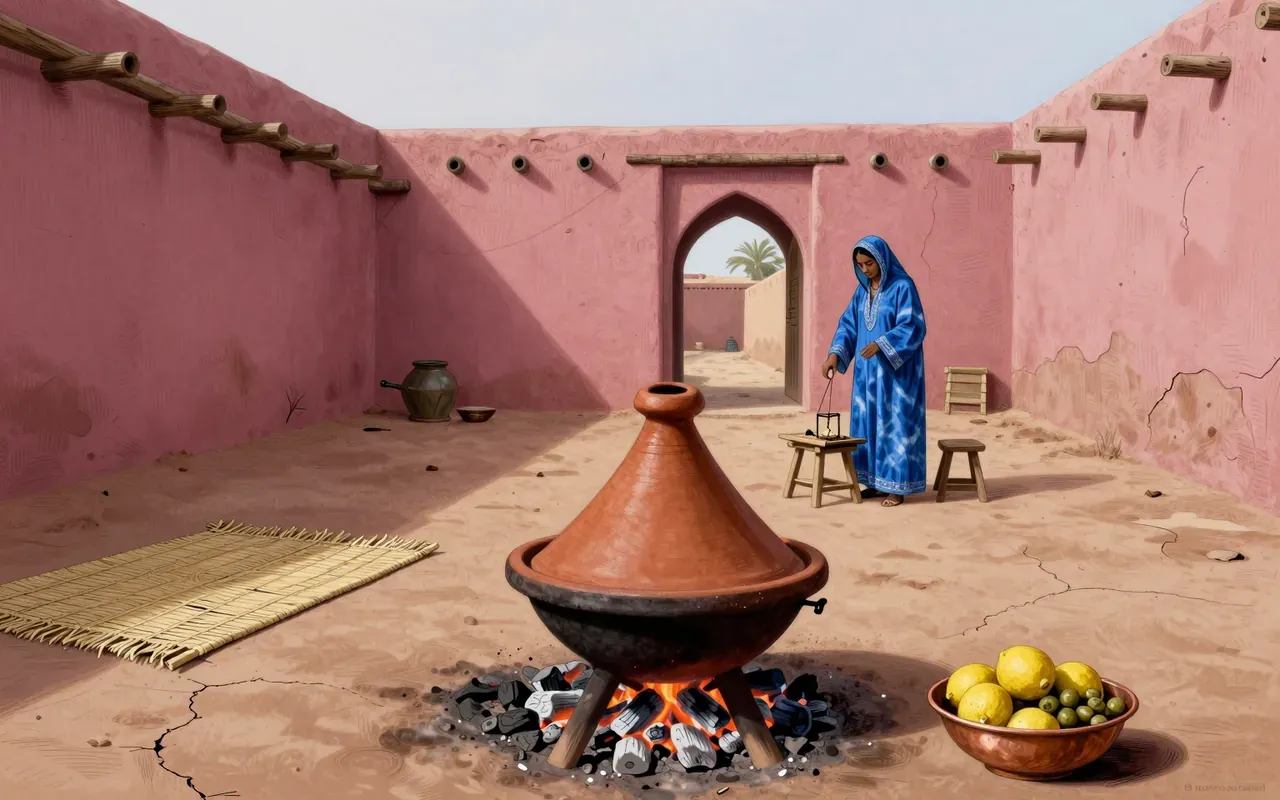
The pot has two parts: a shallow, circular clay skillet and a tall cone- or dome-shaped cover. The stew typically combines spiced meat, poultry or fish with vegetables or fruit. Recipes include tajine zitoun, tajine mtewem and tajine lham-lahlou, and the dish is also called maraq or marqa. Algerian and Moroccan tagines are slow-cooked stews, often with spices, nuts and dried fruits, and they are generally served with bread.
Where it came from
The tagine pot originated in Tafraout, Morocco. Its name derives from Ancient Greek ‘tágēnon’.
The Arabic word ṭajīn comes from the Greek τάγηνον, meaning “frying-pan”. The Mediterranean tágēnon was a shallow, flat-bottomed skillet made of clay. Other North African earthenware vessels take their names from the same Greek word, including the tangia from Marrakesh and the lidless Tunisian tagine. What began in Tafraout is the version with the distinctive cone-shaped lid.
What it gets right
It solves water scarcity with physics: the cone lid traps steam and returns condensation, enabling slow braising with minimal liquid.
Traditional tagine pottery is earthenware, sometimes painted or glazed. The cover is designed to return condensation to the bottom, and some liquid is also gradually absorbed by the unglazed ceramic interior. After most of the liquid has evaporated or been reabsorbed by the food, the hot ceramic works as an oven and bakes it. The food author Paula Wolfert describes tagine cooking as a “magical process” that braises, steams and bakes ingredients in one vessel. The method matters in areas where water supplies are limited or public water is not yet available.
The heat source is part of the method. Tagine is traditionally cooked over hot charcoal in a clay brazier, known as a kanun or majmar, which holds the coals with the pot above them. Modern cooks can use a slow oven or a gas or electric stove top, on the lowest heat that keeps the stew simmering gently, with a diffuser, a circular utensil between pot and flame, to spread the heat evenly. A sudden change in temperature can crack and ruin a tagine pot. Some modern tagines are flameproof stoneware, sometimes called “flameware”, and European makers have produced tagines with heavy cast-iron bottoms that can be heated on a stove to a high temperature. Some ceramic tagines are only decorative serving dishes and cannot withstand cooking heat.
For some dishes the food is given a charred top just before serving. Traditionally the conical lid was swapped for a flat clay dish filled with hot coals, a technique known as “cooking between two fires”; in modern kitchens a broiler does the same job.
Common spices include ginger, cumin, turmeric, cinnamon and saffron, and paprika and chili are used in vegetable tagines. The sweet and sour combination is common, as in lamb with prunes and spices.
What it gets wrong
The pot is the weak point. A clay tagine can crack and be ruined by a sudden change in temperature, which is why it is cooked on the lowest heat that keeps the stew simmering.
Why it matters now
Its minimal-water method remains relevant where infrastructure is limited—and where climate pressures make resource-efficient cooking urgent.
Maghrebi Jews also prepare tagine, owing to their historic presence in North Africa, and it is a very important dish in Sephardic cuisine. It is commonly prepared by Moroccan, Algerian, Tunisian, Libyan and Djerban Jews, and by French Jews, Jewish Americans and Israelis, owing to the large Sephardi populations in those countries. It is commonly made for Shabbat dinners and served with couscous, and also for Rosh Hashanah and the Yom Kippur break-fast. Styles differ by region: Moroccan Jews often cook it with dried fruits, while Tunisian Jews often make a vegetable tagine of potatoes, carrots and zucchini cut into large dice.
Is it worth your time
Yes—if you care how cooking tools solve real-world constraints, not just how they look on a shelf.