10:00in productionCh. 1 · Not Venezuelan. Not Colombian. Pre-Columbian./ 10:00 · ceiling 15 min
Culture · Dishes
Arepa
The arepa is not Venezuelan folklore—it’s 3,000 years of unbroken maize logic.
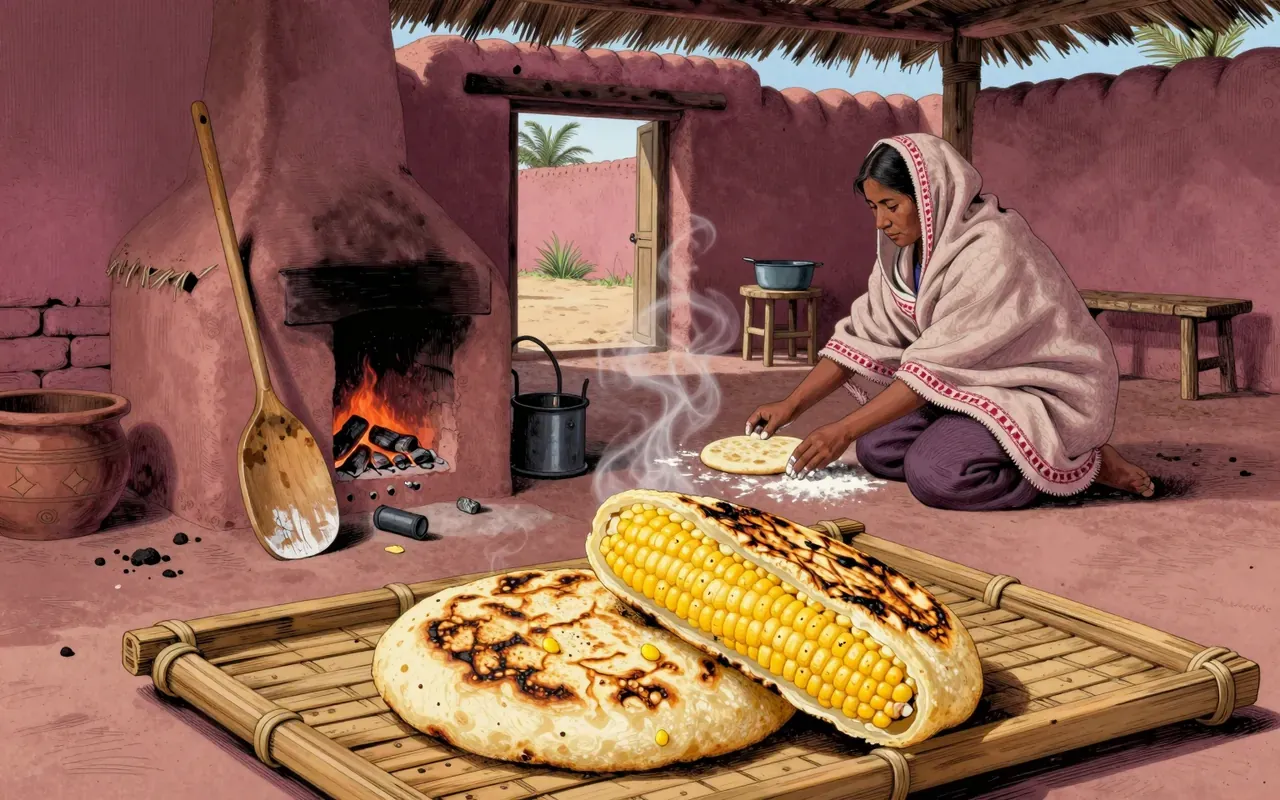
The arepa is a pre-Columbian maize patty originating in Colombia, Panama, and Venezuela. It has remained materially and methodologically unchanged for 3,000 years. Its name derives from the Cumanagoto word for cornbread. Precooked flour—developed by Dr. Luis Caballero Mejías in the 1950s—enabled mass production without altering its core identity. It is neither a modern invention nor a national symbol first, but a living archaeological artefact.
The arepa is a pre-Columbian staple—not a national invention, but a regional inheritance across northern South America.
2:54
3,000 Years Old. Not Myth. Not Legend.
Archaeology confirms arepas were eaten in Colombia 3,000 years ago—and in Venezuela 200 years later.
4:27
Unchanged Since the Muisca
Its form, ingredients, and cooking methods have stayed consistent since before European contact.
6:13
Language and Lab: Two Key Inventions
The word 'arepa' comes from Cumanagoto; the flour that made it mass-producible came from a Venezuelan engineer in the 1950s.
Worth your time?
Yes. Cook the whole thing.
4.5/ 5
What works
As edible archaeology
As resistance to culinary erasure
As proof that simplicity can outlast ideology
What does not
Venezuelan-only origin
20th-century invention
symbol of modern nationalism
culinary fusion product
Cook it if
Indigenous communities of northern South America
Households using maize as daily staple
People studying food continuity under empire
Skip it if
Those seeking novelty or innovation in technique
People looking for a story of rupture or reinvention
The written brief1 min read
What the thing is
An arepa is a flat, round, unleavened patty made from soaked, ground maize kernels or maize flour.
Where it came from
It originated in the area now known as Colombia, Panama, and Venezuela—3,000 years ago in Colombia’s Altiplano Cundiboyacense, and ~2,800 years ago in Venezuela.
What it gets right
It preserves indigenous maize knowledge without dilution. The arepa remains unleavened, maize-only, and methodologically continuous—grilled, baked, or fried—from pre-Columbian times to today.
What it gets wrong
It is often misrepresented as a Venezuelan national dish alone. The evidence places its origins equally in Colombia and Panama, with archaeological proof from both countries—and presence across Bolivia, Ecuador, and Central America.
Why it matters now
It is a rare unbroken thread of pre-contact food practice—proof that culinary continuity is possible despite conquest, industrialisation, and globalisation.
Is it worth your time
Yes—if you care about food that has survived colonisation intact, and want to understand how a single grain can anchor identity across millennia.