8:36in productionCh. 1 · Where it sits on the map/ 8:36 · ceiling 15 min
Culture · Dishes
Mujaddara
A dish that feeds across faiths without asking for shared belief.
Mujaddara is a Levantine lentil-and-rice dish, documented since 1226, eaten across Arab, Christian, Jewish, and Druze communities. It functions as both Lenten observance and daily sustenance. Its endurance lies in its neutrality—not as symbol, but as practice.
It is a Levantine dish—not regional fusion, not diasporic adaptation, but rooted in place.
2:19
What it was before it was named
It was already poor people’s food in the 13th century—no romantic reinvention needed.
3:24
When it becomes ritual
Arab Christians eat it during Lent—making it liturgical, not just culinary.
5:02
Who shares it, and who doesn’t own it
It belongs to Arab, Christian, Jewish, and Druze communities—without belonging to any one of them exclusively.
Worth your time?
Yes. Cook the whole thing.
4.5/ 5
What works
as nourishment
as continuity
as quiet resistance to branding
What does not
invent a movement
define a decade
influence a named artist
displace another dish
Cook it if
people who eat across religious lines
cooks who value function over flourish
readers tired of food writing that confuses longevity with legend
Skip it if
those seeking innovation
those who require provenance beyond 1226
those who need a story with a hero or turning point
The written brief1 min read
What the thing is
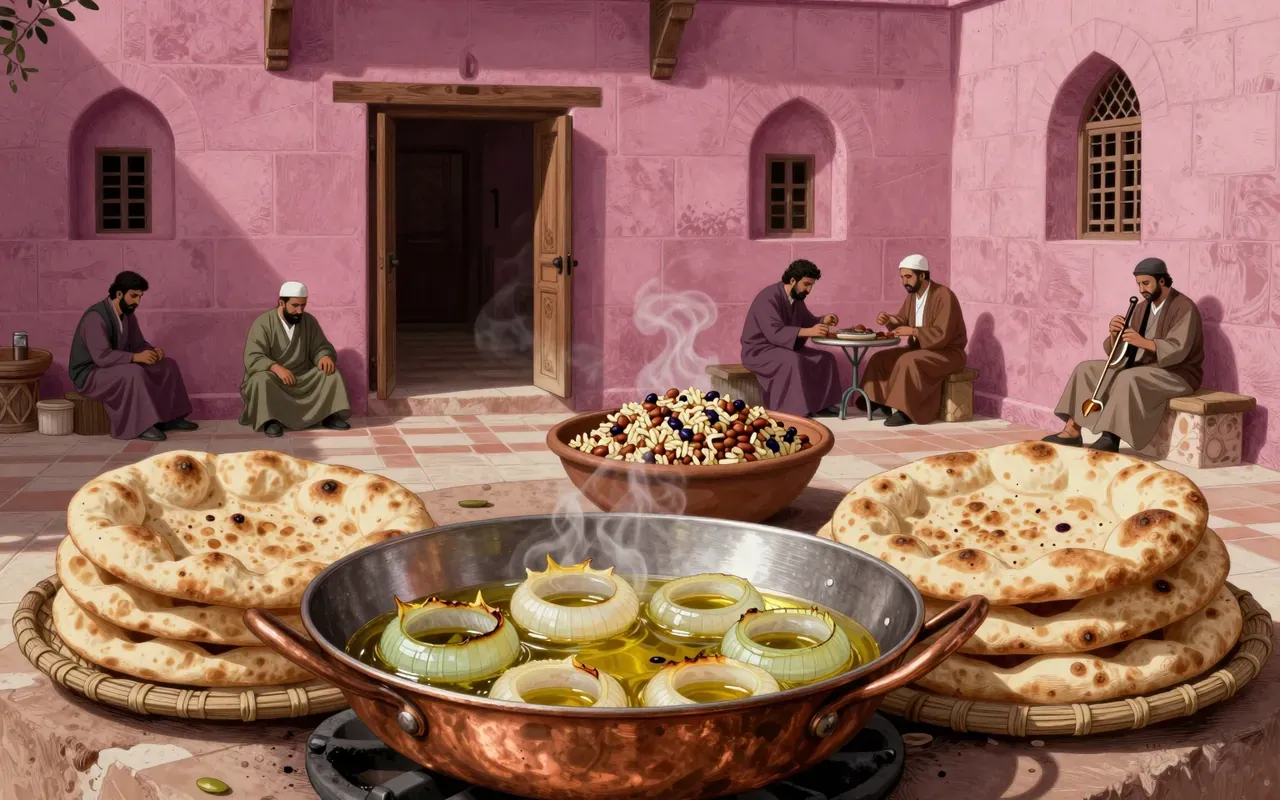
Mujaddara is lentils and rice, garnished with sautéed onions. Its name means ‘pockmarked’, describing how lentils dot the rice.
Where it came from
It emerged in the Levant by 1226. The earliest documented recipe appears in al-Baghdadi’s Kitab al-Tabikh.
What it gets right
It sustains across communities without requiring consensus. Arab, Christian, Jewish, and Druze people all claim it—without needing to agree on origin, meaning, or occasion.
What it gets wrong
Nothing—it is not a claimant, nor a doctrine. But its biblical attribution is unsupported by evidence in the sources.
Why it matters now
It resists flattening into trend or nostalgia. It remains a dish eaten in Lent by Arab Christians and across kitchens where meat is scarce or avoided—unchanged in function, unbranded by time.
Is it worth your time
Yes—if you care about food that carries layered, unromanticised history across religious and economic lines.