foodbriefs
8:36in productionCh. 1 · The pan is the point/ 8:36 · ceiling 15 min
Dishes

Saganaki

Saganaki isn’t about cheese—it’s about fire, noise, and the moment the pan hits the table.

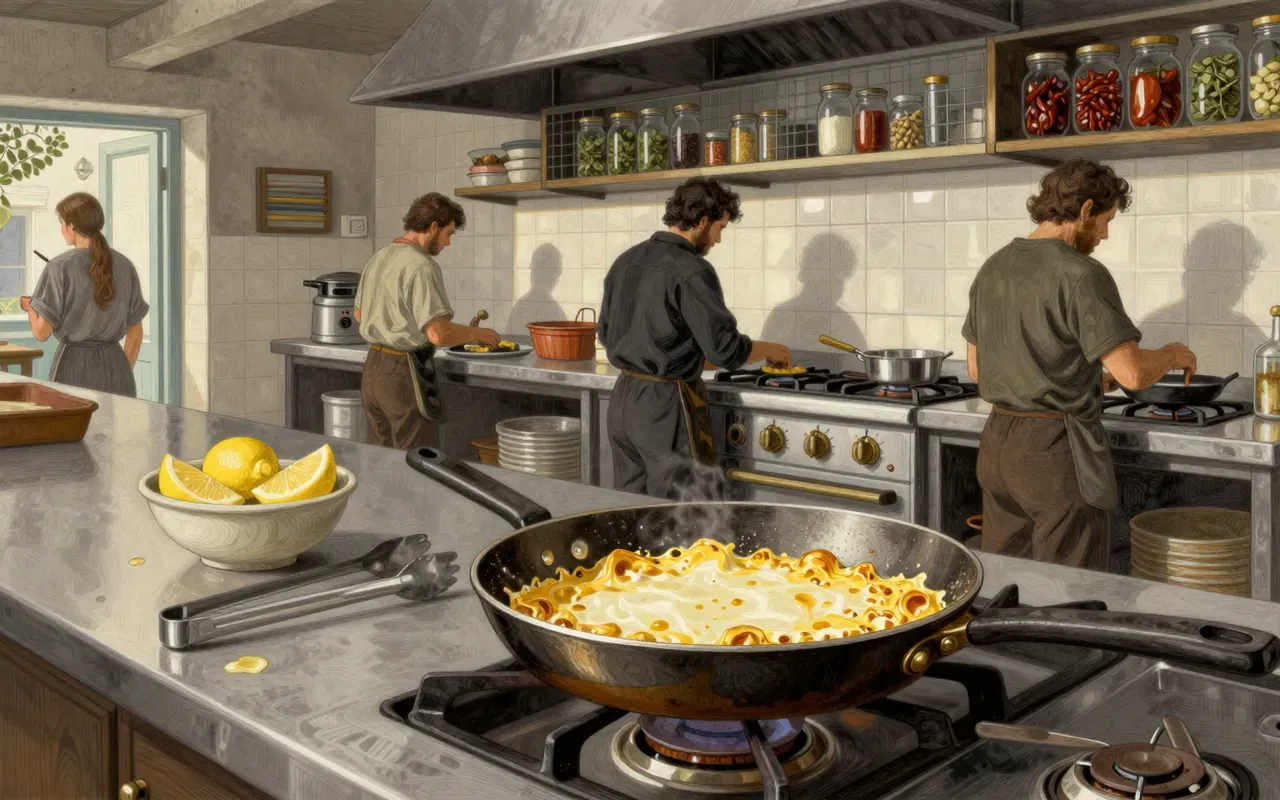
Saganaki is a Greek fried-cheese appetiser cooked in a small frying pan. It uses hard, high-melting-point cheeses—graviera, kefalograviera, kasseri, kefalotyri, halloumi, or sheep’s milk feta—to achieve crisp edges and a molten core. In North America, it is commonly flambéed—a practice that began in 1968 at the Parthenon restaurant in Chicago’s Greektown.

Chapters & takeaways4
  1. 1:00
    The pan is the point

    It is defined by the pan—not the cheese.

  2. 2:06
    Six cheeses, one job

    Graviera, kefalograviera, kasseri, kefalotyri, halloumi, or sheep’s milk feta: all resist melting long enough to brown.

  3. 3:38
    Fire came later

    Flambéing is a North American addition—not Greek tradition.

  4. 5:01
    The birth of the flame

    1968. Chicago’s Greektown. The Parthenon restaurant. A customer’s suggestion became a ritual.

Worth your time?

Yes. Cook the whole thing.

3.5/ 5
What works
  • It delivers immediate, unambiguous satisfaction: golden crust, molten interior, saline punch.
  • It uses accessible cheeses that hold shape under heat.
What does not
  • It does not deliver nuanced texture or layered flavour.
  • It overloads salt and fat.
  • It offers no contrast beyond hot cheese and char.
Cook it if
  • It is for diners who want bold, fast, shareable food with visual flair.
  • It is not for those seeking delicacy, acidity, freshness or restraint.
Skip it if
  • It is not for those seeking delicacy, acidity, freshness or restraint.
The written brief1 min read

What the dish is and where it came from

Saganaki is a Greek fried-cheese appetiser cooked in a small frying pan. It belongs to Greek cuisine, with regional variations across Greece.

How it works, in terms someone would actually use

Saganaki is fried in a small frying pan until the cheese browns and crisps at the edges. The pan’s size concentrates heat, forcing rapid browning without deep frying.

What it gets right

It delivers immediate, unambiguous satisfaction: golden crust, molten interior, saline punch. It uses accessible cheeses—graviera, kefalograviera, kasseri, kefalotyri, halloumi, sheep’s milk feta—that hold shape under heat.

What it does not

It does not deliver nuanced texture or layered flavour. It overloads salt and fat. It offers no contrast beyond hot cheese and char.

What it changed

It turned a simple pan-fried cheese into a theatrical North American restaurant ritual: flambéed tableside, beginning in 1968 at the Parthenon in Chicago’s Greektown.

Who it is for, and who it is not

It is for diners who want bold, fast, shareable food with visual flair. It is not for those seeking delicacy, acidity, freshness or restraint.

Is it worth your time

Yes—if you want crisp-edged, salty cheese with minimal technique. No—if you expect complexity, balance or subtlety.
Same course · Dishes4 of 485
Up next in Food

Pico de gallo

· 8:14

Pico de gallo isn’t just fresh — it’s a structural choice: raw, dry, and assertive by design.

8:14