9:19in productionCh. 1 · National fruit, national dish/ 9:19 · ceiling 15 min
Dishes
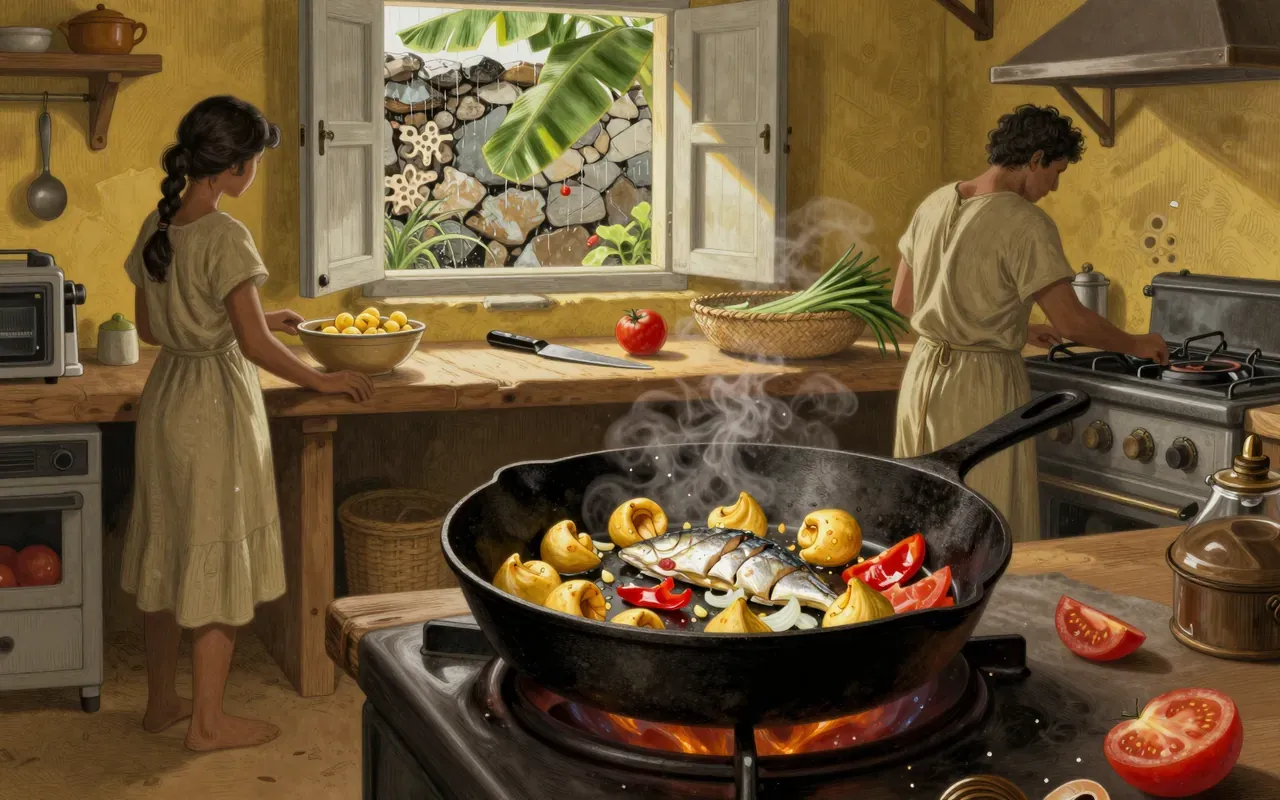
Ackee and saltfish
Jamaica’s national dish is a collision of forced migration and botanical accident—not West African food, but a Jamaican reclamation of both.
Ackee and saltfish is Jamaica’s national dish. It combines ackee—the national fruit, brought from Ghana before 1725—with salted cod introduced for enslaved people as long-lasting protein. It is sautéed, not stewed: boiled ackee meets desalted cod, onions, Scotch bonnet, and tomato. It gets the balance of salt, heat, and creaminess right when timed precisely. It does not reflect West African foodways—where ackee is mostly medicinal—but asserts Jamaican sovereignty over two transplanted staples. Worth your time if you treat it as a technical dish with historical weight, not as folklore.
It is Jamaica’s national dish—and Jamaica’s national fruit—by law and by lore.
2:43
Two imports, one origin story
Ackee came from Ghana before 1725; saltfish came via the slave trade as cheap, durable protein.
4:12
Not West African food—except where it is
In most of West Africa, ackee is medicine or soap—not food—though it *is* eaten in parts of Côte d’Ivoire and Burkina Faso.
5:20
One pan, three non-negotiable steps
Sautéing boiled ackee with desalted cod and Scotch bonnet peppers is the only way the dish holds its shape and balance.
Worth your time?
Yes. Cook the whole thing.
4.5/ 5
What works
centres Jamaica’s national fruit as edible identity
builds heat and sweetness around two preserved staples using local aromatics
turns survival food into sovereign expression
What does not
represent West African food tradition
use fresh cod
avoid reliance on salt
Cook it if
Jamaicans asserting cultural continuity
cooks who respect precise timing and desalting
Skip it if
those seeking West African cooking
cooks unwilling to handle ackee’s toxicity window
The written brief1 min read
What the dish is and where it came from
Ackee and saltfish is Jamaica’s national dish. Ackee arrived from Ghana before 1725. Salted cod was introduced for enslaved people as long-lasting, inexpensive protein. The dish combines boiled ackee with sautéed salt cod and island aromatics.
How it works, in terms someone would actually use
Salt cod is boiled to desalt, then sautéed with boiled ackee, onions, Scotch bonnet peppers, and tomatoes. Spices like pepper and paprika season it. The step that decides whether it works is the balance between the creamy, buttery texture of properly boiled ackee and the firm, salty bite of well-rinsed, desalted cod.
What it gets right
It centres ackee—the national fruit of Jamaica—as both ingredient and identity anchor. It uses aromatics native to the island (Scotch bonnet, tomato, onion) to build layered heat and sweetness around two preserved staples.
What it does not
It does not represent West African culinary tradition, where ackee is rarely eaten as food. It does not use fresh cod or local fish. It does not avoid salt: the cod must be salted, and the dish relies on that salinity.
What it changed
It fused two imported food systems—West African fruit and Atlantic salt-cod trade—into a national symbol that reframes survival food as sovereign cuisine.
Who it is for, and who it is not
It is for Jamaicans asserting cultural continuity. It is not for people seeking West African cooking traditions—or for cooks unwilling to source, desalt, and time ackee precisely.
Is it worth your time
Yes—if you want a dish that delivers sharp salt, bright heat, and vegetal richness in one pan, and are willing to handle ackee’s narrow safe window: undercooked, it is toxic; overcooked, it disintegrates.