foodbriefs
9:53in productionCh. 1 · What it is/ 9:53 · ceiling 15 min
Dishes

Pasta alla gricia

Gricia is not 'Amatriciana minus tomato'—it is the original grammar of Roman pasta.

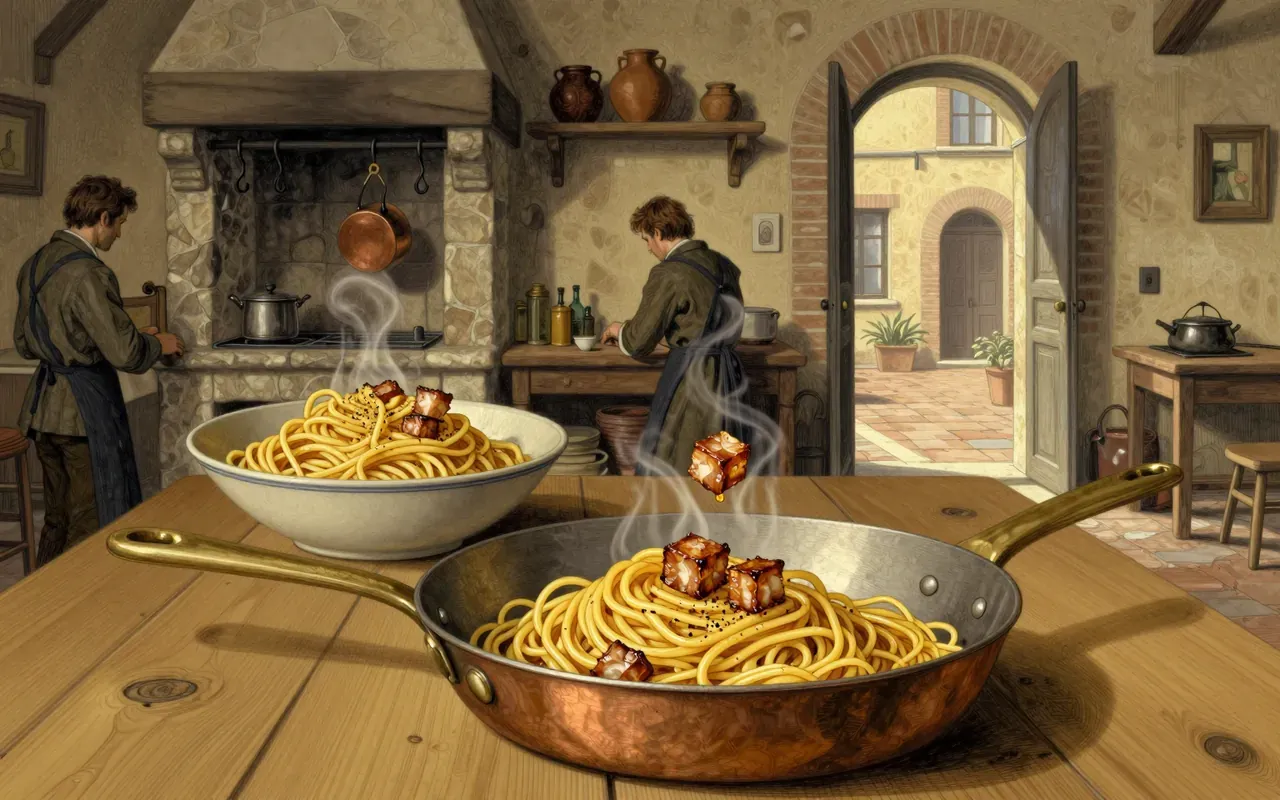
Pasta alla gricia is a Lazio dish built on guanciale, pecorino romano, and black pepper. Its name may derive from Roman street vendors ('grici') or Grisciano, Lazio. It predates tomato-based Amatriciana and shares its core technique and provenance. It is not simplified Amatriciana—it is the foundation.

Chapters & takeaways4
  1. 1:08
    What it is

    It is a Lazio dish defined by three ingredients: guanciale, pecorino romano, and black pepper.

  2. 2:45
    Where the name comes from

    Its name may come from Roman street vendors ('grici') or Grisciano, Lazio—both theories tie it to place, not person.

  3. 4:49
    How it relates to Amatriciana

    Amatrice’s tomato-less Amatriciana of the 1960s confirms gricia is not a derivative—it is a sibling, sometimes called 'amatriciana bianca'.

  4. 6:09
    Why the name fits a pattern

    If named after Grisciano, 'alla grisciana' was reshaped to 'alla gricia' to match occupational dish names like carbonara and scarpariello.

Worth your time?

Yes. Cook the whole thing.

4.5/ 5
What works
  • guanciale fat as cooking medium and seasoning
  • pecorino’s salt cutting through richness
  • black pepper’s heat timed to peak volatility
What does not
  • include tomato
  • use garlic or onion
  • require long cooking
Cook it if
  • cooks who value ingredient fidelity
  • those who understand fat as flavour architecture
Skip it if
  • cooks who rely on sauce volume over emulsion control
  • those who treat pepper as garnish
The written brief1 min read

What the dish is and where it came from

Pasta alla gricia is a traditional pasta dish from Lazio, Italy, made with guanciale, pecorino romano, and black pepper.

How it works, in terms someone would actually use

Guanciale renders its fat slowly over low heat. Pecorino romano is stirred in off the heat to emulsify with the hot fat and pasta water. Black pepper is added at the end for sharp, volatile heat.

What it gets right

It uses guanciale’s unctuous fat as both cooking medium and flavour base. It leverages pecorino’s salt and bite to balance richness. It treats black pepper as structural, not decorative.

What it does not

It does not include tomato, onion, garlic, or cream. It does not rely on long simmering or reduction.

What it changed

It established a template for fat-and-cheese pasta sauces without tomato, prefiguring carbonara and influencing regional variations across central Italy.

Who it is for, and who it is not

It is for cooks who understand that simplicity requires precision. It is not for those who treat pasta as a vehicle for sauce rather than a co-constituent.

Is it worth your time

Yes—if you want a dish that demands attention to texture, timing, and ingredient integrity.
Same course · Dishes4 of 485
Up next in Food

Breadstick

· 10:11

A digestive aid turned dinner-table prop—crisp by design, hollow by nature.

10:11