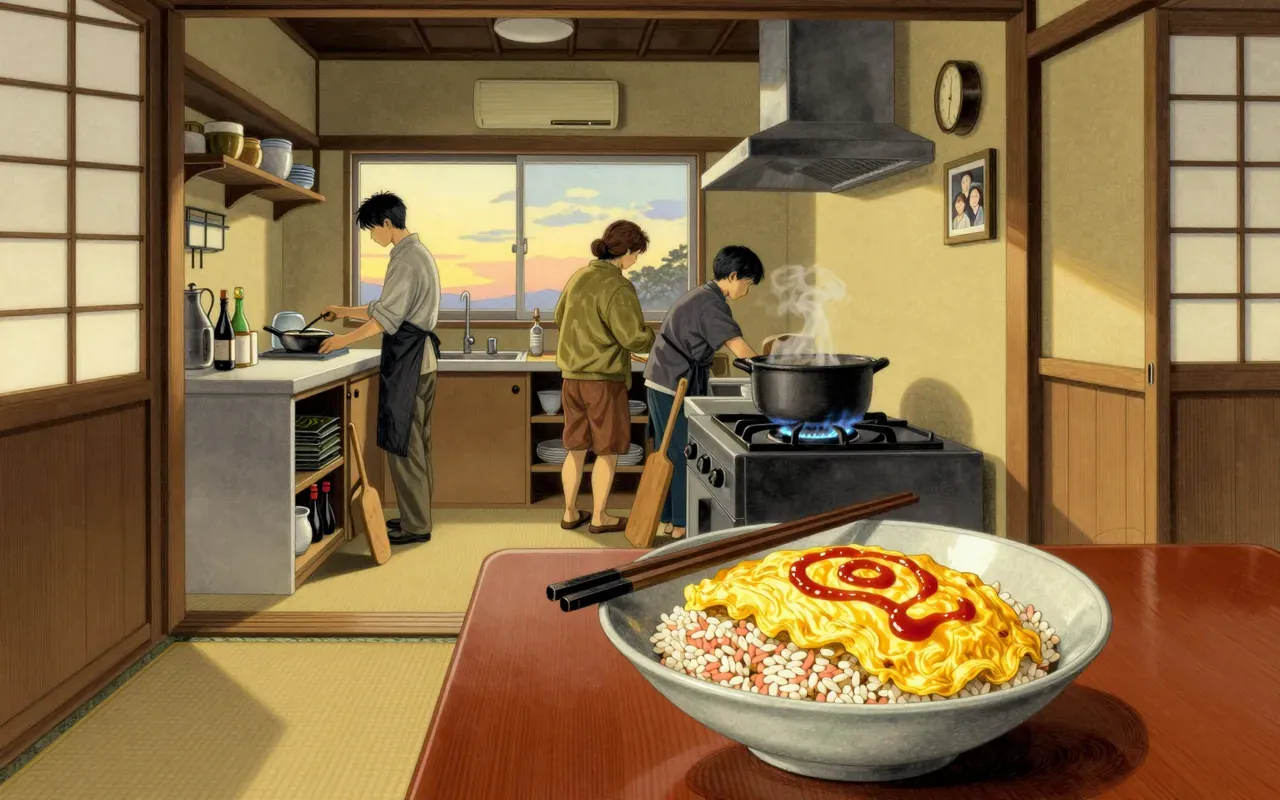
Omurice is a Japanese dish of fried rice topped with or wrapped in a thin omelet. Two origin stories exist: one places its invention around the turn of the 20th century at Renga-tei, a Western-style restaurant in Tokyo’s Ginza district; another credits Hokkyokusei, a Western-style restaurant in Osaka’s Minami district, in 1925.
It works in two common ways: either by covering fully cooked seasoned rice with a completely cooked thin omelet, or by cutting open a half-cooked omelet to spread it over the rice.
It is worth your time if you want a straightforward, egg-and-rice dish with mild seasoning and minimal components.
4 more chaptersFewer chapters
Worth your time?
Selectively. Start with the brief, then cook the parts we point at.
What works
It gets right a simple, cohesive format—ketchup-seasoned chicken rice paired with soft egg—that delivers familiar flavors and textures in one serving.
What does not
It does not offer a vegetable-forward option, as the standard version centers on chicken and ketchup-seasoned rice.
Cook it if
Skip it if
Who should cook it, and who should skipHide who it is for
The written brief1 min read
What the dish is and where it came from
Omurice is a Japanese dish of fried rice topped with or wrapped in a thin omelet. Two origin stories exist: one places its invention around the turn of the 20th century at Renga-tei, a Western-style restaurant in Tokyo’s Ginza district; another credits Hokkyokusei, a Western-style restaurant in Osaka’s Minami district, in 1925.
How it works, in terms someone would actually use
It works in two common ways: either by covering fully cooked seasoned rice with a completely cooked thin omelet, or by cutting open a half-cooked omelet to spread it over the rice. Home cooks typically use the first method.
What it gets right
It gets right a simple, cohesive format—ketchup-seasoned chicken rice paired with soft egg—that delivers familiar flavors and textures in one serving.
What it does not
It does not offer a vegetable-forward option, as the standard version centers on chicken and ketchup-seasoned rice.
What it changed
It changed children’s meals in Japan by becoming a staple of okosama-ranchi (children’s lunch).
Who it is for, and who it is not
It suits someone looking for an egg-and-rice dish, including the home meals and children’s lunches in which it is commonly served.
Is it worth your time
It is worth your time if you want a straightforward, egg-and-rice dish with mild seasoning and minimal components.