What the thing is
Parmigiano Reggiano is a hard, granular, unpasteurized cow’s milk cheese.
Where it came from
It originated in Emilia-Romagna and Lombardy. The earliest written record dates to 1254.
According to legend, it was created in the Middle Ages in the comune of Bibbiano, in the province of Reggio Emilia, and production soon spread to the Parma and Modena areas. Boccaccio praised it in 1348, inventing in the Decameron a “mountain, all of grated Parmesan cheese” where people do nothing but make macaroni and ravioli. During the Great Fire of London in 1666, Samuel Pepys buried his “Parmazan cheese” along with his wine to save it. Casanova, writing of the mid-18th century, remarked that the name Parmesan was a misnomer, since the cheese was produced around Lodi, in Lombardy, not Parma.
Some, including Alberto Grandi, have claimed that early Parmesan was softer and fattier, with a black rind resembling the Wisconsin version. Against that, it is well documented as dry, hard and grainy since the 15th century.
The name comes from the Italian provinces of Parma and Reggio Emilia, and the cheese is also made in the part of Bologna west of the River Reno, in Modena, and in the part of Mantua on the south bank of the River Po.
What it gets right
It enforces terroir through law. Every wheel must be made in Emilia-Romagna or Lombardy, from raw cow’s milk, aged at least 12 months, and inspected by hammer at 12 months.
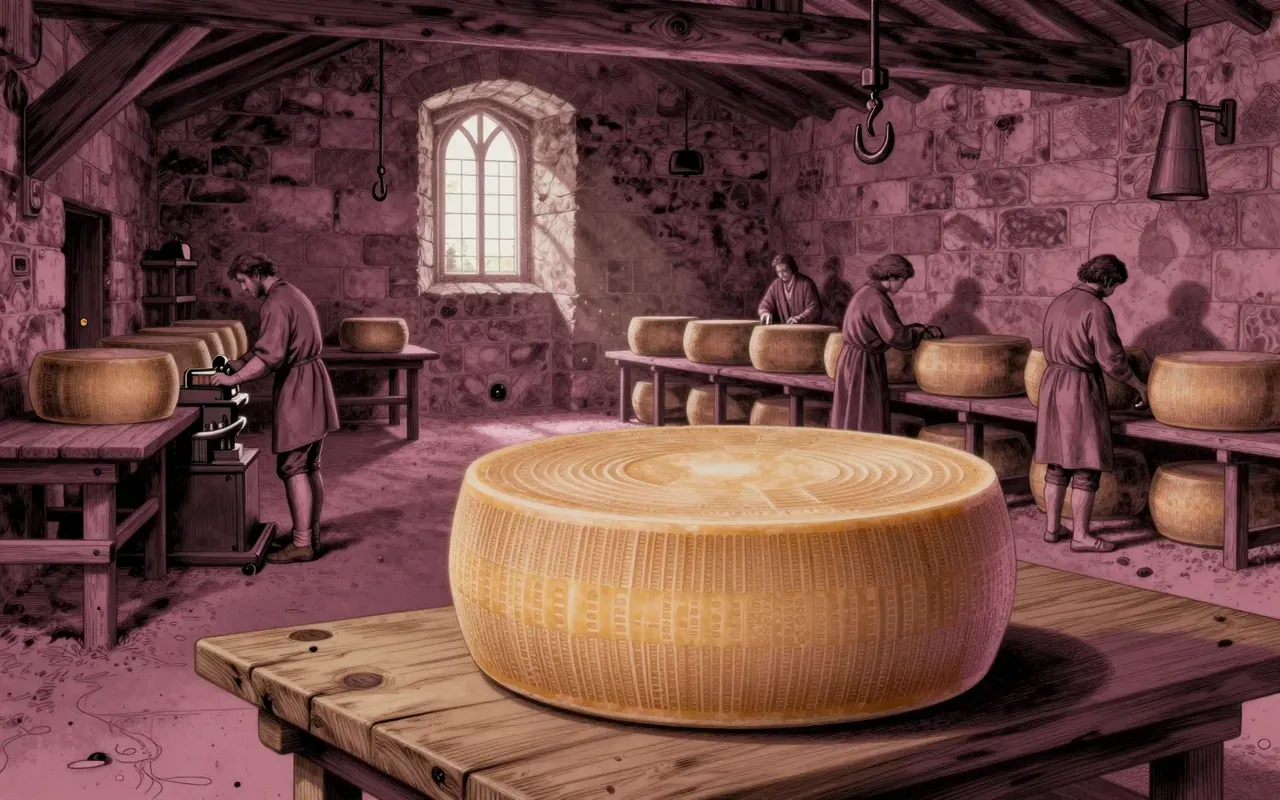
The method explains the rules. The whole milk of the morning milking is mixed with the naturally skimmed milk of the previous evening, giving a part-skim mixture that is pumped into copper-lined vats, which heat evenly and add copper ions. Only natural whey culture is allowed as a starter, together with calf rennet. The curd is broken into pieces about the size of rice grains and then collected in muslin, and each vat of 1,100 litres of milk makes two cheeses. After a day or two in a form the wheel gets a belt that imprints the name, plant number and month and year of production on the rind, then spends 20 to 25 days in a brine bath. Salt is the only additive allowed. It then ages on wooden shelves where each cheese is cleaned and turned every seven days.
At 12 months, one of the country’s 25 master graders, the battitore, taps each wheel with a small hammer to find cracks and voids, which takes about six or seven seconds. There are three grades. The top wheels are heat-branded with the Consorzio’s logo; the second tier keeps the mark but has lines or crosses marked all the way around the rind to tell buyers it is not top quality; the third has all rind markings stripped. Seals also record the dairy’s number, the production month and year, a code for the wheel and the length of aging.
The Consorzio was founded in 1928, and the name became a certified name in 1955. In 2008 an EU court held that Parmesan in Europe refers only to Parmigiano Reggiano. As of 2017, about 3.6 million wheels a year were made, using about 18% of all the milk produced in Italy.
What it gets wrong
It fails outside the EU. In the US, ‘Parmesan’ is unregulated, and widespread adulteration is documented.
The US Standard of Identity for “Parmesan and Reggiano cheese” requires cow’s milk, curing for 10 months or more, no more than 32% water and no less than 32% milkfat in the solids. Canada’s regulation sets moisture and fat levels but no aging time. Some American generic Parmesan is sold already grated and has been aged for less than 12 months. Manufacturers have been investigated for exceeding the 4% cellulose limit allowed as an anticaking agent; in one case the FDA found that no Parmesan cheese was used to make a Pennsylvania firm’s grated cheese labeled “Parmesan”, and the manufacturer pleaded guilty. In 2021 the farmer association Coldiretti reported that 90% of “Italian sounding” cheese sold in the United States as parmesan, mozzarella, grana and gorgonzola was made domestically.
Why it matters now
It is a working model of how place-based food protection can resist industrial dilution—while exposing the limits of that protection beyond EU borders.
The cheese has also been a target of organised crime in Italy: between November 2013 and January 2015 a gang stole 2,039 wheels from warehouses, and some banks, such as Credito Emiliano, accept Parmesan as collateral for a loan. It is high in glutamate, as much as 1.2 g per 100 g, which accounts for its strong umami taste. Its hard crust ends are sometimes simmered in soups, broths and sauces to add flavour.
Is it worth your time
Yes—if you care about food as a legal, geographical and sensory fact, not just a flavour.