foodbriefs
12:48in productionCh. 1 · Not ancient. Not always basil./ 12:48 · ceiling 15 min
Dishes · Technique

Pesto

Pesto genovese is not a blender hack — it is a mortar ritual that fails if you rush the garlic-and-pine-nut cream.

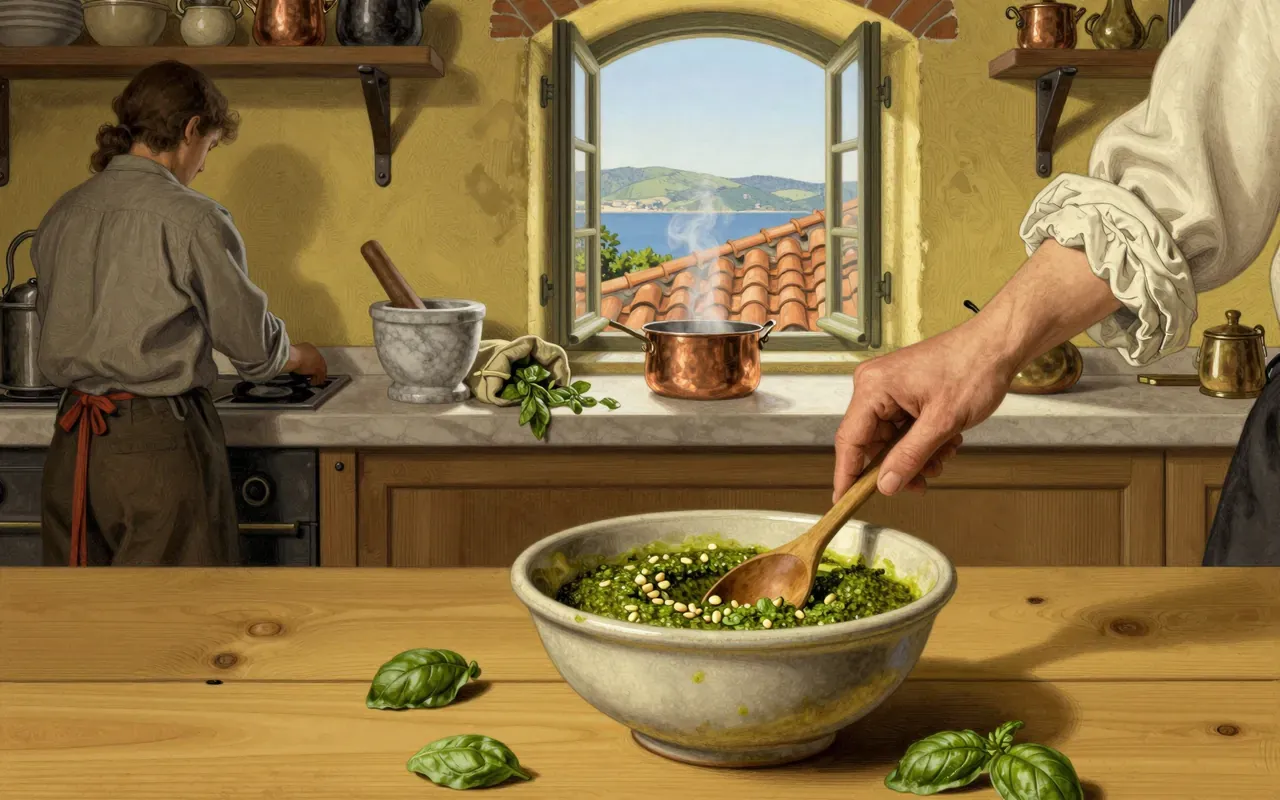
Pesto genovese is a Genoese paste made by pounding Genovese basil, garlic, pine nuts, coarse salt, Parmesan or Grana Padano, pecorino sardo, and extra-virgin olive oil in a marble mortar. It evolved from Roman moretum and medieval Genoese agliata. Basil entered only in the 1850s. Its method — order, tool, and timing — defines its success.

Chapters & takeaways6
  1. 1:06
    Not ancient. Not always basil.

    Basil entered pesto only in the 1850s — centuries after Roman moretum and medieval agliata.

  2. 2:38
    Order is non-negotiable.

    The mortar sequence matters: garlic and pine nuts first, then basil and salt, then cheese, then oil — each step changes the paste’s structure.

  3. 3:53
    Two ancestors. One fork.

    Moretum used vinegar and herbs; agliata used walnuts and garlic — neither had basil or cheese as we know them in pesto.

  4. 5:01
    Butter was once in the mortar.

    An 1852 recipe used butter and Dutch cheese — proof that early versions were unstable experiments, not fixed tradition.

  5. 6:26
    Three ingredients hold the paste together.

    Genovese basil, pine nuts, and coarse salt are structural — not decorative — ingredients.

  6. 7:40
    Genoa owns the mortar.

    Pesto genovese is defined by place, method, and season — not by being 'Italian' in general.

Worth your time?

Yes. Cook the whole thing.

4.5/ 5
What works
  • locks in basil’s aroma by avoiding blades and heat
  • balances salt, fat, and umami so garlic stays present but never raw
  • uses coarse salt to abrade basil leaves gently, releasing oil without oxidation
What does not
  • tolerate heat
  • store well
  • use walnuts
  • use vinegar
Cook it if
  • cooks who value texture over speed
  • eaters who seek immediacy of herb flavour
Skip it if
  • those who need a pantry staple
  • those who expect a sauce that reheats
  • those who scale recipes without degradation
The written brief2 min read

What the dish is and where it came from

Pesto genovese is a fresh, uncooked paste from Genoa. It is made with Genovese basil, garlic, pine nuts, coarse salt, Parmesan or Grana Padano, pecorino sardo, and extra-virgin olive oil. Its name comes from the Genoese verb pestâ — ‘to pound’.

How it works, in terms someone would actually use

Pesto genovese works by pounding garlic and pine nuts to a cream, then grinding in basil and coarse salt, then folding in grated cheese with extra-virgin olive oil — all in a marble mortar with a wooden pestle. The friction and controlled pressure release basil’s volatile oils without bruising them into bitterness. The oil emulsifies only as needed, keeping the paste vibrant and loose enough to cling to trofie or lasagne.

What it gets right

It locks in basil’s aroma by avoiding blades and heat. It balances salt, fat, and umami so the garlic stays present but never raw. It uses coarse salt to abrade basil leaves gently, releasing oil without oxidation.

What it does not

It does not tolerate heat, blanching, or long storage. It does not use parsley as a primary herb. It does not include butter as a binding agent in its modern traditional form — that appears only in an 1852 variant. It does not use walnuts or vinegar.

What it changed

It replaced vinegar and walnuts with basil and pine nuts, shifting from a pungent, preserved medieval mash to a fragrant, perishable summer paste. It moved from seafarers’ rations to a regional emblem tied to Genoa’s terroir and seasonal basil.

Who it is for, and who it is not

It is for cooks who value texture over speed, and eaters who seek immediacy of herb flavour. It is not for those who need a pantry staple, a sauce that reheats, or a recipe that scales without degradation.

Is it worth your time

Yes, if you want a fresh, herb-forward condiment that demands attention to texture and timing. It is not worth your time if you expect speed, shelf stability, or machine consistency.

Same course · Dishes4 of 485
Up next in Food

Picadillo

· 8:13

Picadillo is not one dish—it’s a grammar of mince, tomato, raisin, and olive, spoken in Cuban, Mexican, and Filipino dialects.

8:13