Saved
Culture · Ingredients

Polenta

Polenta is not Italian heritage—it’s maize replacing famine food, then migrating with the poor.

Worth your time?4/5Yes.Cook the whole thing.What works, what does not, who it is for ↓
9:11in productionCh. 1 · Not ancient. Not maize-born./ 9:11 · ceiling 15 min
4 chapters · 9:11Ceiling 15:00

The brief is written and checked. The video joins this page when it is cut.4 chapters · 1 min read · 9:11 planned

Read the brief

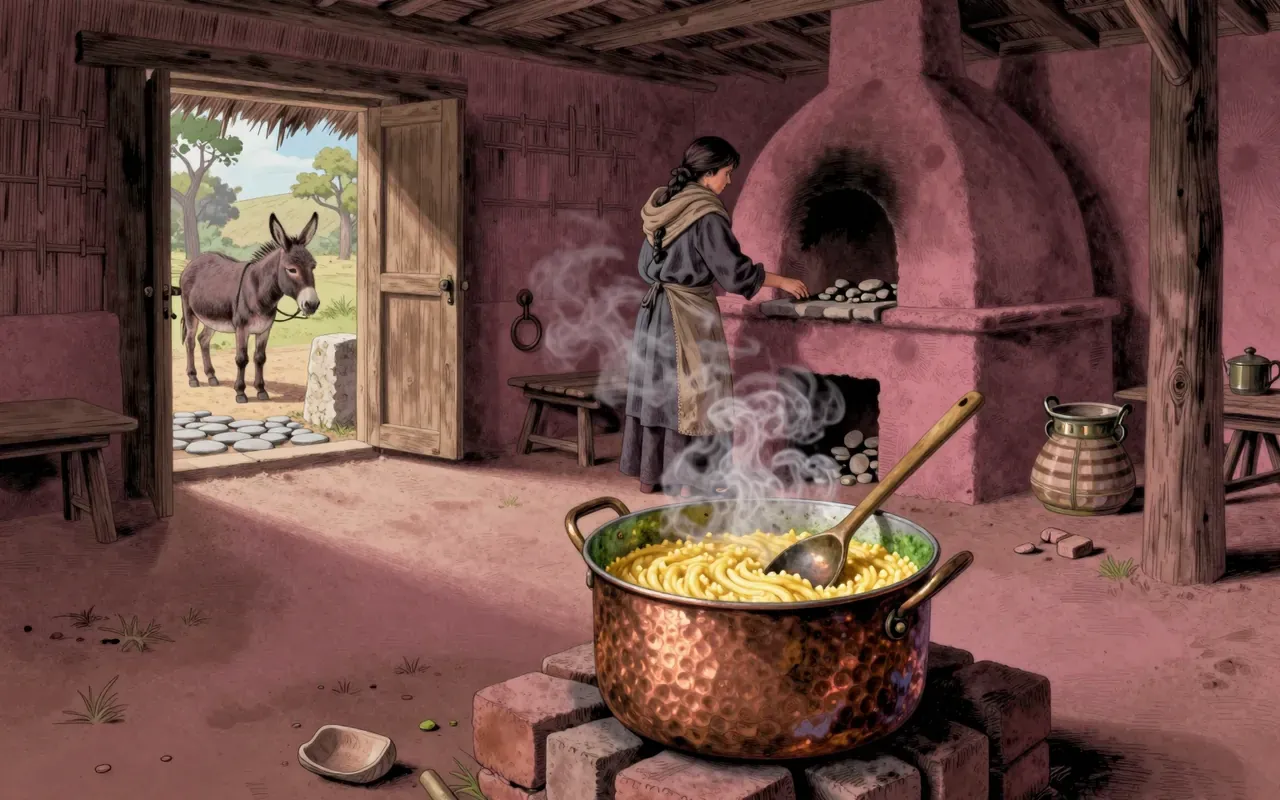
Polenta is boiled cornmeal mush. It replaced older Roman grain porridges after maize arrived in Europe in the 16th century. Its texture depends on grind. It spread across southern Europe and South America via Italian migration. It was historically eaten by lower classes. It is now a staple across multiple national cuisines—but its history is one of substitution, not continuity.

Chapters & takeaways4
  1. 1:01
    Not ancient. Not maize-born.

    Polenta is a maize-based dish that replaced older Roman grain mushes like puls and pulmentum.

  2. 2:26
    Five grains before corn

    Before 16th-century maize, polenta used farro, chestnut flour, millet, spelt and chickpeas.

  3. 3:44
    Coarse or creamy. Poor or poorer.

    Grind determines texture; class determined its role—as daily sustenance for the lower classes.

  4. 5:13
    Carried south, not served up.

    It anchors cuisines across southern Europe and South America because Italians carried it—not as luxury, but as survival.

1 more chapterFewer chapters
Worth your time?

Yes. Cook the whole thing.

4/ 5
What works
  • cooking
  • eating
  • remembering
What does not
  • celebrity
  • innovation
  • luxury
  • trend
Cook it if
  • cooks
  • historians
  • migrants
Skip it if
  • gourmands seeking novelty
  • fine-dining critics
Who should cook it, and who should skipHide who it is for
The written brief1 min read

What the thing is

Polenta is boiled cornmeal mush. Yellow maize is usual. Buckwheat or white maize may substitute. Texture depends on grind: coarse for firm, fine for creamy.

Where it came from

It derives from Roman puls or pulmentum. Before maize arrived in the 16th century, it used farro, chestnut flour, millet, spelt and chickpeas. Italian immigrants brought it to southern Brazil in the late 19th century.

What it gets right

It turns cheap, starchy, shelf-stable grain into nourishment through friction and time. Coarse grind yields firmness. Fine grind yields cream. Method matches material.

What it gets wrong

It pretends to be Italian tradition while being a post-16th-century maize adaptation. Its ‘authenticity’ erases the pre-maize grains—farro, chestnut flour, millet, spelt, chickpeas—that fed people for centuries.

Why it matters now

It reveals how food staples travel with poverty—not prestige—and how migration remakes ingredients across continents. It is eaten in northern and central Italy, Swiss Italian, southern French, Croatian, Slovenian, Serbian, Romanian, Brazilian, Uruguayan and Argentinian cuisines. Its consumption was traditionally associated with lower classes.

Is it worth your time

Yes—if you care about how staple foods encode class, migration and substitution. It is not a curiosity. It is infrastructure.
Same course · Culture4 of 156
9:36
GyrosGyros is a Greek dish of vertically roasted meat—traditionally pork—served in pita with tzatziki and sides. Its cooking method began in 19th-century Bursa. It entered Greece via Asia Minor Greeks displaced in 1922–23. By 1970, it was fast food in Athens, Chicago, and New York City. Its name is a direct translation of the Turkish ‘döner’. It matters as evidence of how cuisine moves not through choice, but through expulsion.
8:46
Chow meinChow mein is a linguistic and culinary shorthand that began as a descriptive Chinese term, travelled with immigrants, and was industrialised into something unrecognisable from its source. It matters not as heritage, but as evidence of how food loses fidelity in transit—and gains utility in translation.
10:34
Ropa viejaRopa vieja is a stewed beef dish with regional variations across Spain, Latin America, and the Philippines. It originated as 'handrajos', a Sephardic Jewish Shabbat stew in the Iberian Peninsula. It spread to North Africa and the Canary Islands before arriving in Cuba via Canary Island immigrants—first reported there in 1857. Its name likely refers to either leftover ingredients or the tattered appearance of the shredded meat. Though now considered a Cuban national dish, that designation obscures its deeper origins and transmission path.
8:05
Spring rollSpring rolls are a pan-Asian food category rooted in mainland Chinese seasonal practice—specifically the Spring Festival—and defined by regional variation in wrapper, filling, and preparation. They are not inherently fried, nor exclusively savoury, and their name reflects a temporal origin now largely absent in global use.
Up next in Food

Ponzu

· 1:18

A tart, thin, citrus-based Japanese sauce, often blended with soy sauce and used as a dressing or dip.

1:18