8:46in productionCh. 1 · It’s Just a Description/ 8:46 · ceiling 15 min
Culture · Dishes
Chow mein
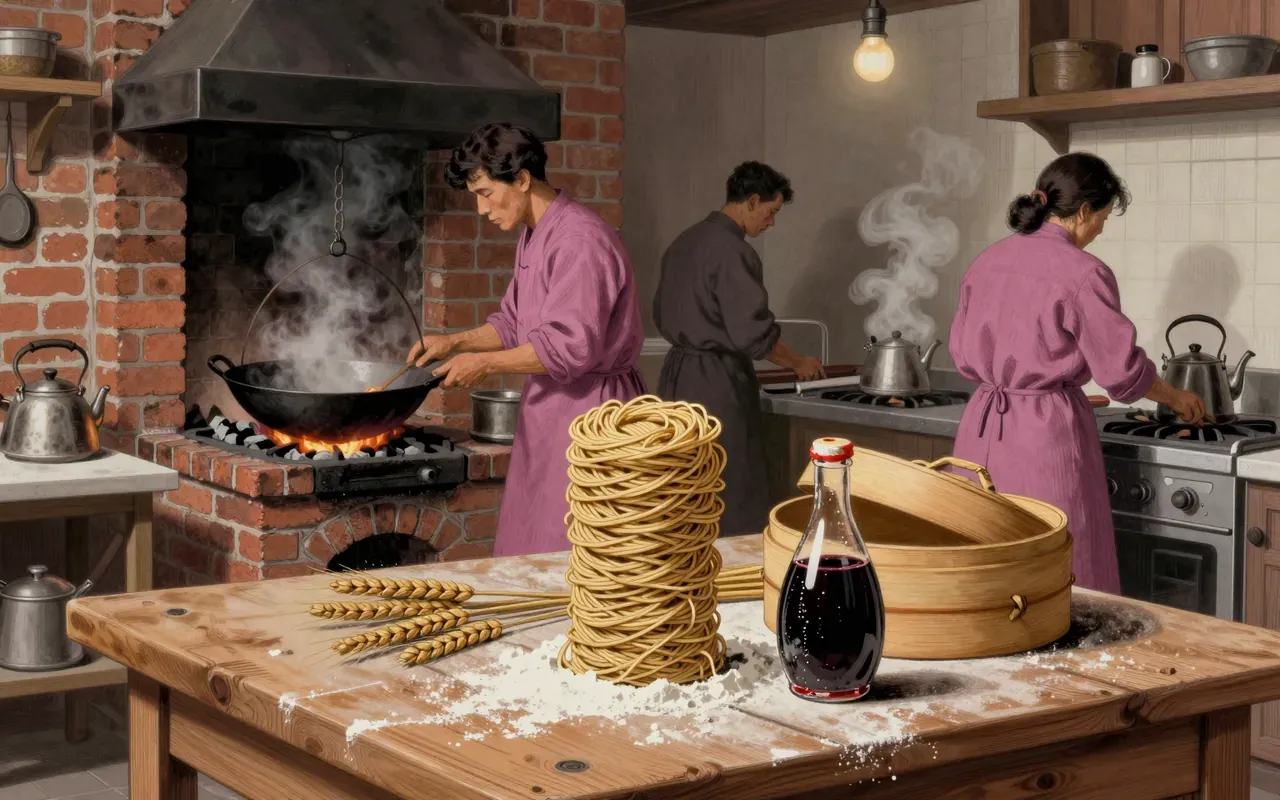
Chow mein isn’t Chinese food—it’s the first global fast-food algorithm disguised as a dish.
Chow mein is a linguistic and culinary shorthand that began as a descriptive Chinese term, travelled with immigrants, and was industrialised into something unrecognisable from its source. It matters not as heritage, but as evidence of how food loses fidelity in transit—and gains utility in translation.
Chow mein means stir-fried noodles—not a dish, not a brand, but a literal translation of a cooking method.
1:41
Taishan in the Pan
It arrived in the US with Cantonese-speaking immigrants from Taishan and Guangdong during the California gold rush.
2:59
First Word, Then Can
The word ‘chow mien’ appeared in print in 1890—decades before it became a mass-market product.
4:11
The Can Broke the Chain
Chun King canned chow mein in 1946—standardising, simplifying, and severing it from its origins.
5:18
One Name, Many Displacements
Variations existed across China for centuries—but global versions rarely reflect that depth.
Worth your time?
Yes. Cook the whole thing.
3.5/ 5
What works
as a case study in semantic erosion
as proof that infrastructure shapes taste more than tradition does
What does not
it is not iconic
it is not timeless
it is not groundbreaking
Cook it if
people who study food systems
readers tracking linguistic drift
anyone suspicious of culinary nostalgia
Skip it if
those seeking authentic recipes
fans of retro Americana without critique
readers who conflate popularity with origin
The written brief1 min read
What the thing is
Chow mein is stir-fried noodles—literally. Not a recipe, not a brand, not a cuisine: a cooking method rendered into a loanword and then a commodity.
Where it came from
It originated in China as chǎomiàn—a regional dish with variations across centuries. Chinese immigrants from Taishan and Guangdong brought it to the US during the California gold rush era. The term entered American English in 1890.
What it gets right
It preserves the core technique: stir-frying noodles. It delivers speed, adaptability, and texture contrast. It works as portable, scalable, modular food.
What it gets wrong
Most global versions discard the regional specificity of chǎomiàn—its Cantonese roots, Taishan immigrant lineage, and centuries of Chinese noodle-frying methods. The canned 1946 US version bears almost no resemblance to any traditional preparation.
Why it matters now
It reveals how migration flattens complexity, how language fossilises process, and how industrial food systems repurpose cultural forms into shelf-stable abstractions.
Is it worth your time
Yes—if you care how food migrates, mutates, and masks its origins under the weight of diaspora and commerce.