Saved
Dishes · Culture

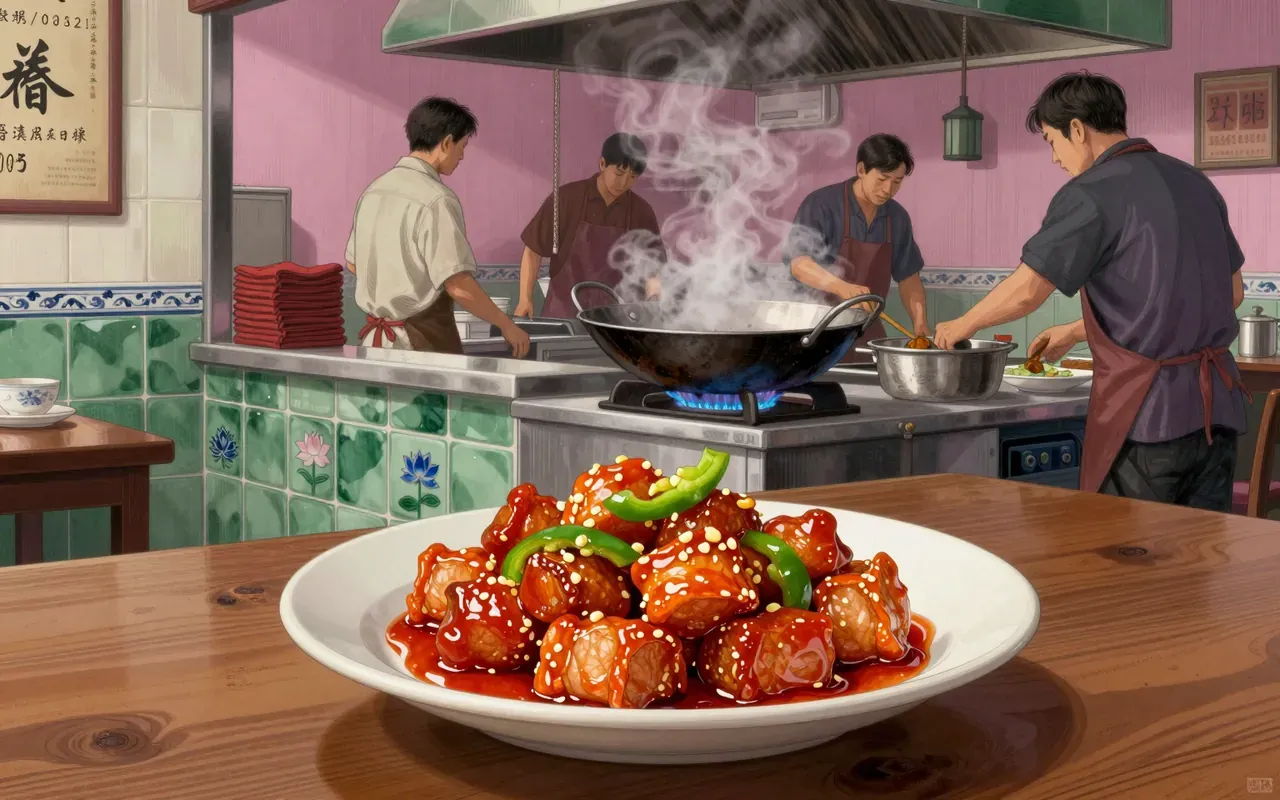
Sweet and sour pork

A dish built to please foreigners became the most misunderstood ambassador of Cantonese cooking.

Worth your time?4/5Yes.Cook the whole thing.What works, what does not, who it is for ↓
10:55in productionCh. 1 · What it is/ 10:55 · ceiling 15 min
6 chapters · 10:55Ceiling 15:00

The brief is written and checked. The video joins this page when it is cut.6 chapters · 1 min read · 10:55 planned

Read the brief

Sweet and sour pork is a Cantonese dish adapted for foreigners in 18th-century Guangdong, then carried to the US by Chinese migrants during the Gold Rush and railroad era. It uses double-frying—a genuine Cantonese technique—to deliver crispness, and its sauce balances sweetness and acidity to suit Western palates. It succeeds as functional diplomacy on a plate, but fails as cultural shorthand: it stands in for all Chinese food while erasing its Cantonese specificity and diasporic labour. Its endurance proves adaptation isn’t betrayal—it’s strategy.

Chapters & takeaways6
  1. 1:05
    What it is

    It is fried pork with sweet and sour sauce—not a stew, not a stir-fry, not a fusion experiment.

  2. 2:03

    It began in 18th-century Canton, travelled to Guangdong’s foreign enclaves under the Qing Dynasty, then crossed to California and rail towns by the 1900s.

  3. 3:16
    Why it worked

    It was designed for Western taste—and succeeded precisely because it did.

  4. 4:41

    Double-frying isn’t American improvisation—it’s a documented Cantonese technique for texture.

  5. 5:47

    Calling it 'inauthentic' misses that authenticity wasn’t the goal—survival and legibility were.

  6. 7:00
    Why it mattered then—and still does

    It became a staple not because it was traditional, but because it was portable, scalable, and defensible in hostile terrain.

3 more chaptersFewer chapters
Worth your time?

Yes. Cook the whole thing.

4/ 5
What works
  • as a case study in culinary translation
  • as evidence of Cantonese technical rigour
  • as a lens on immigrant pragmatism
What does not
  • it is iconic
  • it defined a generation
  • it influenced chefs
  • it changed fine dining
Cook it if
  • people who eat takeout without thinking about why it looks like this
Skip it if
  • people who assume 'Chinese food' is monolithic
Who should cook it, and who should skipHide who it is for
The written brief1 min read

What the thing is

Sweet and sour pork is fried pork tenders coated in sweet and sour sauce.

Where it came from

It originated in 18th-century Cantonese cuisine, gained traction among foreigners in Guangdong during the Qing Dynasty, then spread to the US via Chinese immigrants during the mid-19th century Gold Rush and early 20th-century railroad construction.

What it gets right

It delivers crisp texture through double-frying—a real Cantonese technique—and balances acidity and sweetness in a way that reliably satisfies broad palates.

What it gets wrong

It flattens Cantonese culinary logic into a single sticky sauce, erasing regional variation and misrepresenting itself as ‘Chinese’ rather than Cantonese-American.

Why it matters now

It reveals how diaspora cuisine operates not as compromise but as strategic translation—shaped by access, exclusion, and the need to be legible to power.

Is it worth your time

Yes—if you care how food adapts, survives, and carries contradiction in its batter.
Same course · Dishes4 of 496
9:47
CurryCurry is a colonial construct—not a dish, but a British-imposed category that flattened India’s named, regional preparations into a single, exportable idea. Its method relies on frying spices in fat to build flavour; its history begins with medieval Indian broths seasoned with black pepper, then pivots decisively with the arrival of chilies, tomatoes, and potatoes. It gets right the centrality of spiced, saucy cooking—but fails as a descriptor, because Indians never called their food ‘curry’. It changed how the world talks about food: turning rogan josh into ‘a curry’, sambar into ‘a curry’, and vindaloo into ‘a curry’. It is for readers who want to question labels, not follow recipes. Worth your time only if you treat it as a case study in cultural translation—not a cooking guide.
1:19
PastillaPastilla is a layered pie from Morocco, also found in Algeria and Tunisia (as malsouka). Its name derives from the Spanish word pastilla, though theories attribute its arrival to Andalusi Muslims, Sephardic Jews, or Ottoman-era Algerian migrants. It is not definitively tied to one origin.
10:34
Ropa viejaRopa vieja is a stewed beef dish with regional variations across Spain, Latin America, and the Philippines. It originated as 'handrajos', a Sephardic Jewish Shabbat stew in the Iberian Peninsula. It spread to North Africa and the Canary Islands before arriving in Cuba via Canary Island immigrants—first reported there in 1857. Its name likely refers to either leftover ingredients or the tattered appearance of the shredded meat. Though now considered a Cuban national dish, that designation obscures its deeper origins and transmission path.
0:56
ShakshoukaShakshouka is a Maghrebi dish of eggs poached in a sauce of tomatoes, olive oil, peppers, onion, and garlic, commonly spiced with cumin, paprika, and cayenne pepper.
Up next in Food

Tabbouleh

· 0:57

A Levantine salad of finely chopped parsley, soaked bulgur, tomatoes, mint, and onion, seasoned with olive oil, lemon juice, salt, and sweet pepper.

0:57