10:01in productionCh. 1 · Not Just Grilling/ 10:01 · ceiling 15 min
Culture · Dishes
Asado
Asado isn’t barbecue—it’s a two-hour social contract written in smoke and salt.
Asado is a South American barbecue tradition centred in Argentina and Uruguay, involving specific techniques (al asador, a la parrilla), fuel choices (native-tree charcoal or embers), unmarinated salted meats, staged serving (offal first), and regional variations in method and accompaniments.
Asado is both method and gathering—rooted in Argentina and Uruguay, not generic 'Latin American' culture.
2:02
Fire Is Not Neutral
Uruguay cooks over embers; Argentina uses quebracho charcoal—no shared fuel, no shared origin story.
2:54
Salt. Sequence. Silence.
No marinade. Only salt. And offal always serves first—structure before substance.
3:58
Two Ways to Hold Fire
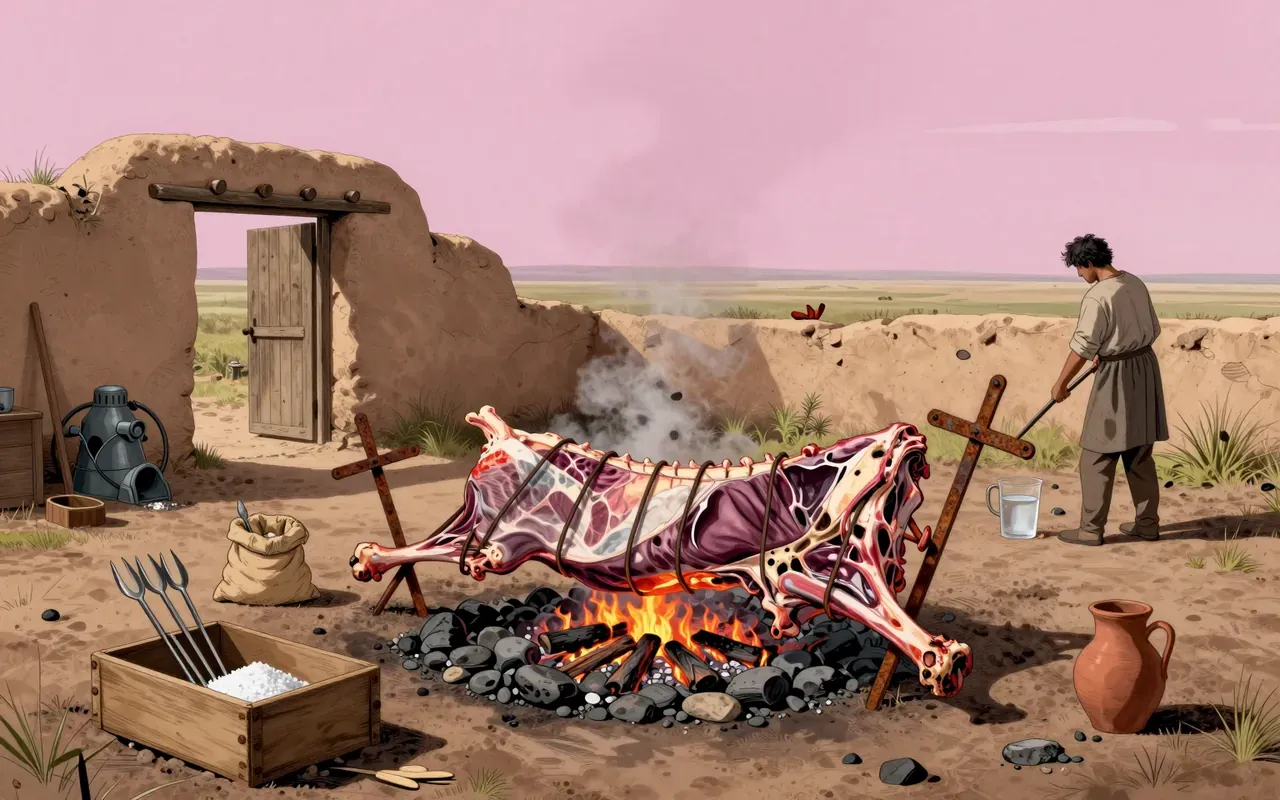
Al asador means whole carcass on crosses; a la parrilla means grill over formed charcoal—two distinct architectures of heat.
4:49
Only Fire. Only Grill.
Beef, pork, chicken, chorizo, morcilla—all cooked open-flame or on parrilla. Nothing fried, baked, or steamed.
6:15
Borders Matter
It spreads to Brazil (Rio Grande do Sul), Chile and Paraguay—but remains anchored in Argentina and Uruguay.
Worth your time?
Yes. Cook the whole thing.
4.5/ 5
What works
as a counterpoint to fast-food logic
as evidence of regional divergence within shared language
What does not
influence
define
launch
start
Cook it if
people who cook with intention
those studying food as social infrastructure
Skip it if
casual diners seeking recipes
readers expecting cultural mythmaking
The written brief1 min read
What the thing is
Asado is a South American cooking technique and social event, centred in Argentina and Uruguay. It is defined by open-fire or parrilla grilling, native-tree charcoal (or embers), unmarinated salted meats, and staged serving.
Where it came from
It emerged in the cattle-raising cultures of Argentina and Uruguay, where fire, native wood, and offal were material necessities—not stylistic choices.
What it gets right
It treats meat as a medium for time, heat, and communal sequencing—not flavour enhancement. Salt only. No marinade. Offal first. Two hours slow. This is discipline disguised as leisure.
What it gets wrong
It assumes uniformity across borders. Uruguay rejects charcoal entirely; Argentina embraces it. The document shows no shared standard—only contested practice.
Why it matters now
It resists industrial speed and globalised seasoning. Its insistence on salt-only, ember-only, offal-first order is a quiet rebuttal to convenience culture—and a reminder that ritual is not ornament, but infrastructure.
Is it worth your time
Yes—if you care how food encodes social rhythm, regional identity, and unspoken hierarchy. It is not a recipe. It is a protocol.