1:05in productionCh. 1 · What the dish is and where it came from/ 1:05 · ceiling 15 min
Baking · Food history
Ciabatta
An Italian white bread invented in 1982, flat and holey, made with high-hydration dough and strong flour.
Ciabatta is an Italian white bread created in 1982 by baker Arnaldo Cavallari in Adria, Veneto. He named it ciabatta polesana after Polesine, the local area.
Ciabatta is an Italian white bread created in 1982 by baker Arnaldo Cavallari in Adria, Veneto.
0:10
How it works, in terms someone would actually use
It uses a very high hydration dough made with strong (high-gluten) flour.
0:21
What it gets right
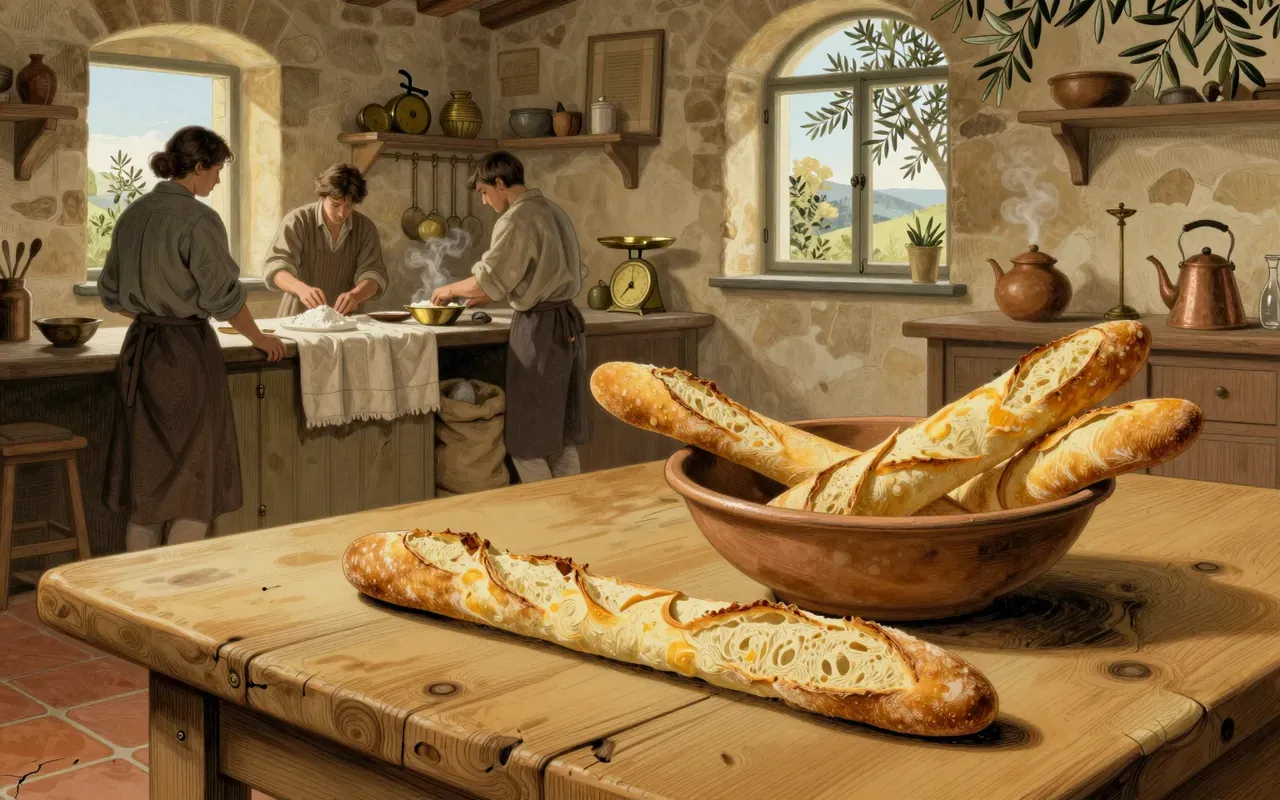
Its large holes and flat, broad shape make it well-suited for sandwiches — the stated purpose behind its invention as an Italian alternative to the French baguette.
0:32
What it does not
It is not a traditional or historic Italian bread, nor is it described as suitable for uses beyond sandwiching.
0:40
What it changed
It changed Italian bakery practice by offering a domestically developed sandwich bread in direct response to competition from imported French baguettes.
0:48
Who it is for, and who it is not
It is for people seeking an Italian-made sandwich bread.
0:57
Is it worth your time
It is worth your time if you want a modern Italian sandwich bread with a distinctive open crumb and flat profile.
Worth your time?
Selectively. Start with the brief, then cook the parts we point at.
What works
Its large holes and flat, broad shape make it well-suited for sandwiches — the stated purpose behind its invention as an Italian alternative to the French baguette.
What does not
It is not a traditional or historic Italian bread, nor is it described as suitable for uses beyond sandwiching.
Cook it if
Skip it if
The written brief1 min read
What the dish is and where it came from
Ciabatta is an Italian white bread created in 1982 by baker Arnaldo Cavallari in Adria, Veneto. He named it ciabatta polesana after Polesine, the local area.
How it works, in terms someone would actually use
It uses a very high hydration dough made with strong (high-gluten) flour. The method involves adapting traditional bread recipes over several weeks to achieve a soft, wet dough.
What it gets right
Its large holes and flat, broad shape make it well-suited for sandwiches — the stated purpose behind its invention as an Italian alternative to the French baguette.
What it does not
It is not a traditional or historic Italian bread, nor is it described as suitable for uses beyond sandwiching.
What it changed
It changed Italian bakery practice by offering a domestically developed sandwich bread in direct response to competition from imported French baguettes.
Who it is for, and who it is not
It is for people seeking an Italian-made sandwich bread. It is not for those looking for a historic, regional, or low-hydration loaf.
Is it worth your time
It is worth your time if you want a modern Italian sandwich bread with a distinctive open crumb and flat profile.