foodbriefs
9:34in productionCh. 1 · First citation/ 9:34 · ceiling 15 min
Baking · Food history

Pandoro

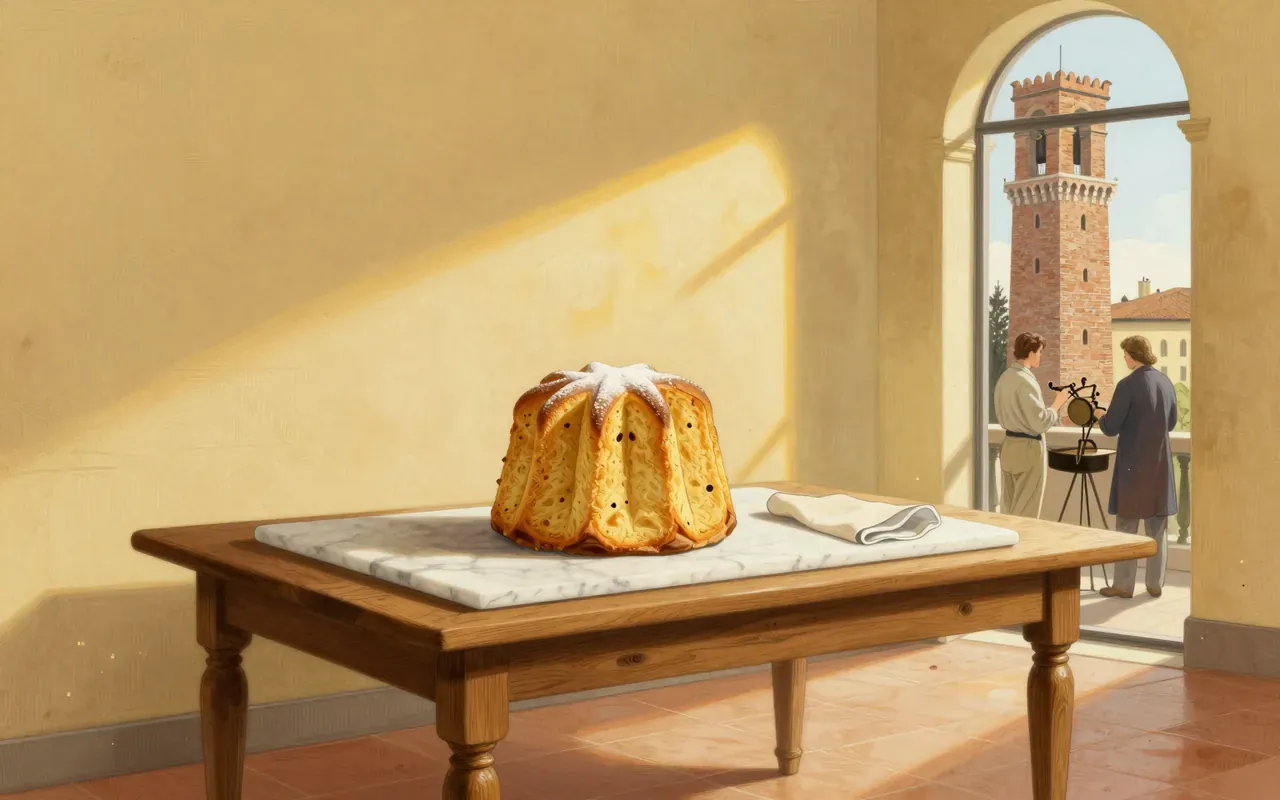
Pandoro is not a cake — it’s a butter-rich, star-shaped bread whose industrial patent in 1894 turned Verona’s century-old formula into Italy’s most geometrically correct Christmas ritual.

Pandoro is a Veronese sweet bread, first cited in the 18th century. Its formula was developed and perfected in Verona over a century. Domenico Melegatti patented its industrial production on October 30, 1894.

Chapters & takeaways4
  1. 1:04
    First citation

    The first written record of pandoro dates to the 18th century — not earlier, not later.

  2. 2:50
    Made in Verona

    Verona is where pandoro’s formula was developed and perfected — not Milan, not Naples, not Rome.

  3. 4:12
    The 1894 patent

    Domenico Melegatti patented industrial production of pandoro on October 30, 1894 — a fixed date, not an approximation.

  4. 5:27
    From workshop to factory

    A century of local refinement met industrial scale on a single day in Verona.

Worth your time?

Yes. Cook the whole thing.

4/ 5
What works
  • balance of richness and lightness
  • high butter content without greasiness
  • fine crumb without density
  • clean, milky-sweet flavour
What does not
  • spiced
  • fruited
  • sourdough-leavened
  • long-fermented
Cook it if
  • people who value precise texture
  • people who value regional specificity
  • people who value the history of industrial food production
Skip it if
  • people who prefer spiced festive breads
  • people who prefer fruited festive breads
  • people who prefer sourdough-leavened festive breads
The written brief1 min read

What the dish is and where it came from

Pandoro is an Italian sweet bread from Verona, first cited in the 18th century. Its formula was developed and perfected in Verona over a century. It is associated with Christmas.

How it works, in terms someone would actually use

Pandoro is a leavened, enriched sweet bread made with flour, eggs, butter, sugar and yeast. It rises slowly, then bakes in an eight-pointed star-shaped mould that gives it its signature shape and crisp, golden crust.

What it gets right

It gets right the balance of richness and lightness: high butter content without greasiness, fine crumb without density, and a clean, milky-sweet flavour that lets the wheat and egg shine.

What it does not

It does not rely on dried fruit, citrus zest or spices. It contains no raisins, candied peel or cinnamon. Its sweetness comes solely from sugar and butter, not fermentation by-products or caramelisation.

What it changed

Domenico Melegatti’s 1894 patent changed pandoro from a local Veronese specialty into a reproducible, scalable product — the first step toward national distribution and seasonal standardisation.

Who it is for, and who it is not

It is for people who value precise texture, regional specificity and the history of industrial food production. It is not for people who prefer spiced, fruited or sourdough-leavened festive breads.

Is it worth your time

It is worth your time if you want a rich, buttery, tender crumb with a distinct regional identity and a clear industrial turning point — but only if you bake or buy it fresh, as it stales quickly and loses its delicate structure.
Same course · Baking4 of 24
Up next in Food

Parmigiana

· 9:07

Parmigiana is not about melting cheese—it’s about holding eggplant together without smothering it.

9:07