8:10in productionCh. 1 · One Palm, One Name/ 8:10 · ceiling 15 min
Culture · Ingredients
Coconut
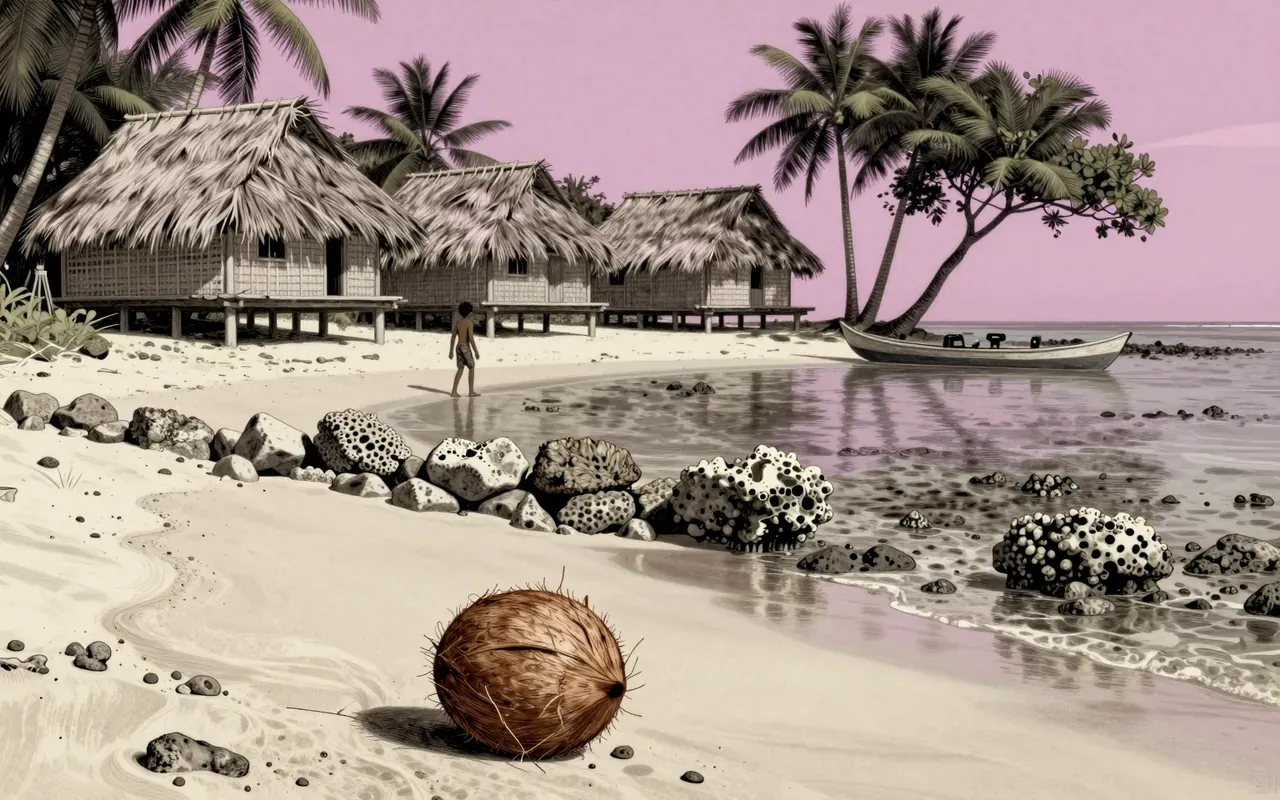
The coconut is not nature’s accident—it’s Austronesian infrastructure.
The coconut is a botanical singleton, a human-dispersed staple, and an archaeological artefact—not a romantic symbol. Its story belongs to Austronesian seafarers, not colonial trade routes or modern wellness trends.
Its center of origin is the Central Indo-Pacific—not the Caribbean, not Africa, not the Americas.
3:03
Human Hands, Not Ocean Currents
Austronesians domesticated it during their expansion (3000–1500 BCE) and cultivated it by 1000 BCE.
4:05
No Drift, Only Carry
Drift models prove coconuts could not cross the Pacific without human help.
5:08
Today’s Scale, Yesterday’s Canoe
In 2024, global production hit 65.5 million tonnes—with three countries supplying most of it.
Worth your time?
Yes. Cook the whole thing.
4/ 5
What works
culture/society
culture/food
What does not
culture/art
culture/arts
culture/cities
culture/fashion
Cook it if
anthropologists
archaeologists
food-systems researchers
Skip it if
chefs
food-writers
wellness influencers
The written brief1 min read
What the thing is
Cocos nucifera is a palm species. It is the only living member of the genus Cocos.
Where it came from
It originated in the Central Indo-Pacific—specifically Southeast Asia, New Guinea, and the Southwestern Pacific.
What it gets right
It establishes the coconut as a domesticated crop, not a wild one. It confirms Austronesian peoples carried it deliberately across oceans. It shows cultivation and artificial selection were underway by ~1000 BCE.
What it gets wrong
It treats ‘coconut’ as a single entity. It does not distinguish between Pacific and Indian Ocean lineages—though genetic evidence places the center of origin solely in the Central Indo-Pacific.
Why it matters now
Because 65.5 million tonnes were produced in 2024—73% by Indonesia, India, and the Philippines—and its dispersal maps onto one of humanity’s largest premodern seaborne expansions.
Is it worth your time
Yes—if you care about how human migration shaped global food systems. No—if you expect cultural symbolism or culinary history.