9:02in productionCh. 1 · No wild ginger/ 9:02 · ceiling 15 min
Culture · Ingredients
Ginger
A rhizome without a wild ancestor—and a remedy without robust evidence.
Ginger is a human-made plant—domesticated, transported, recorded, and traded long before modern science tested it. Its cultural weight exceeds its evidential weight.
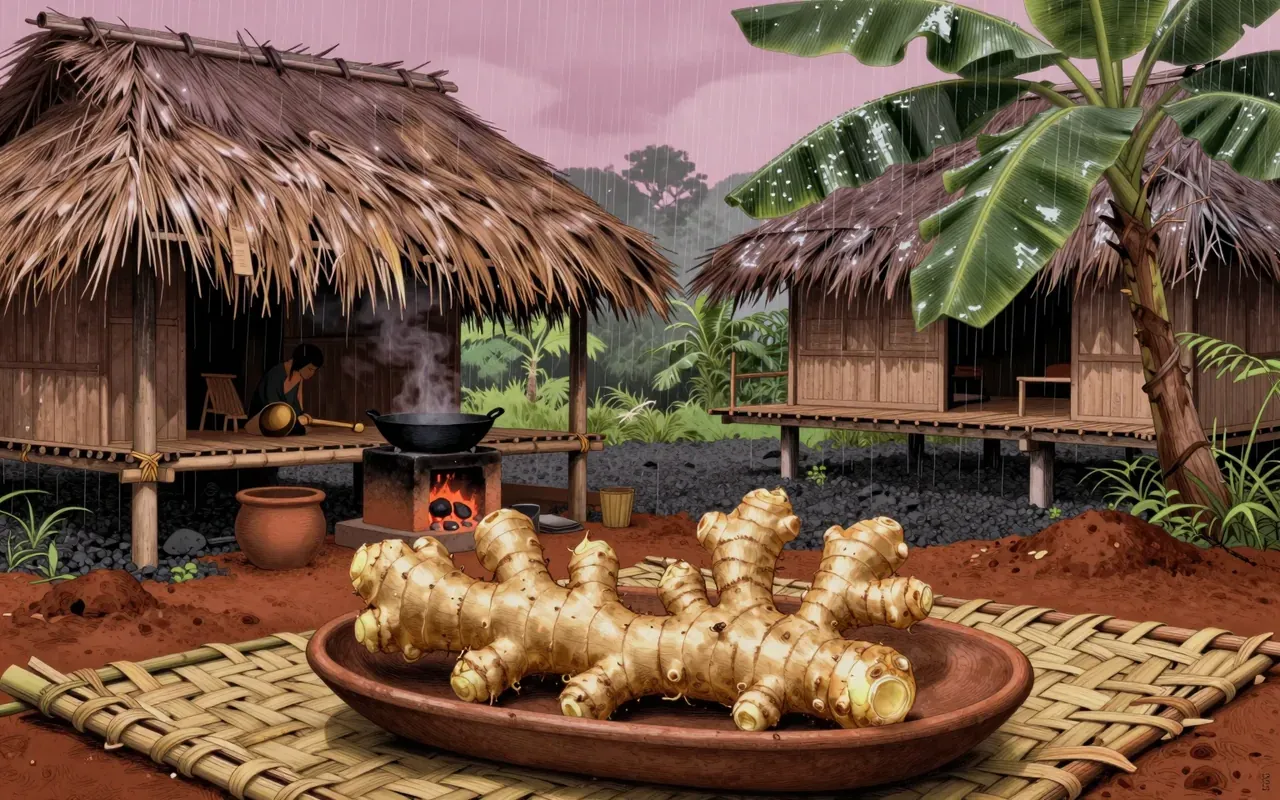
Ginger has no wild form. It was made by Austronesian peoples in Maritime Southeast Asia.
1:54
Sailed with the spice
Austronesian seafarers carried ginger across the Indo-Pacific over 5,000 years ago.
3:00
First in the Analects
The first written record appears in China’s Warring States period—not in India or Arabia, as often assumed.
4:33
Led by volume, not origin
India grows nearly half the world’s ginger—but not because it invented or first traded it.
5:44
Nausea claims lack rigour
Its use against pregnancy nausea rests on low-quality evidence—not clinical consensus.
Worth your time?
Yes. Cook the whole thing.
3.5/ 5
What works
as-a-tracer-of-human-migration
as-a-marker-of-prehistoric-agriculture
as-a-global-commodity-before-the-colonial-era
What does not
medicine
nutrition
modern-culinary-innovation
Cook it if
food-historians
anthropologists
trade-scholars
Skip it if
clinicians
cooks-seeking-new-techniques
wellness-enthusiasts
The written brief1 min read
What the thing is
Ginger is a flowering plant whose rhizome is used as a spice and folk medicine. It has no wild form. It is a true cultigen.
Where it came from
Ginger originated in Maritime Southeast Asia. It was domesticated by the Austronesian peoples and carried across the Indo-Pacific during their expansion beginning around 5,000 BP.
What it gets right
Ginger established itself as a globally traded rhizome before written records existed in most of the world. Its domestication by Austronesian peoples was deliberate, ancient, and geographically expansive.
What it gets wrong
It is widely claimed to treat nausea—but evidence for pregnancy-related nausea is low-quality, and there is no good evidence it helps chemotherapy-induced nausea or other diseases.
Why it matters now
In 2023, global ginger production reached 4.9 million tonnes—India alone produced 45%—making it a cornerstone of agro-trade, yet its medical reputation outstrips its evidence base.
Is it worth your time
Yes—if you care about how a single plant shaped trade, medicine and taste across millennia. No—if you expect clinical proof or modern culinary innovation.