foodbriefs
9:47in productionCh. 1 · What it is/ 9:47 · ceiling 15 min
Dishes

Crêpe

A wrinkled sacrament turned snack: crêpes are liturgy made edible.

Crêpes are not French invention—they are Roman liturgy repatriated. Their endurance lies in minimalism, flexibility, and ritual anchoring.

Chapters & takeaways6
  1. 1:00
    What it is

    Crêpes are defined by method—not ingredients: unleavened batter, cooked flat on heat.

  2. 2:03
    Where it came from

    The word 'crêpe' means 'curled'; the dish began as papal sacramental bread in Rome in 472.

  3. 2:54
    What it gets right

    It splits cleanly into sweet and savoury—and accommodates almost any filling without structural failure.

  4. 3:57
    What it displaces

    Its French identity is retrospective: it replaced sacramental bread only after returning home from Rome.

  5. 5:05
    How it adapts

    Flambéing—as in Crêpes Suzette—proves it can absorb theatricality without sacrificing function.

  6. 5:53
    Why the date holds

    Candlemas on 2 February remains its anchor—linking liturgy, pilgrimage, and pancakes in one date.

Worth your time?

Yes. Cook the whole thing.

4/ 5
What works
  • as ritual
  • as vessel
  • as linguistic fossil
What does not
  • iconic
  • groundbreaking
  • seminal
Cook it if
  • anyone who tracks how religion becomes routine
Skip it if
  • those seeking culinary innovation or technical novelty
The written brief1 min read

What the thing is

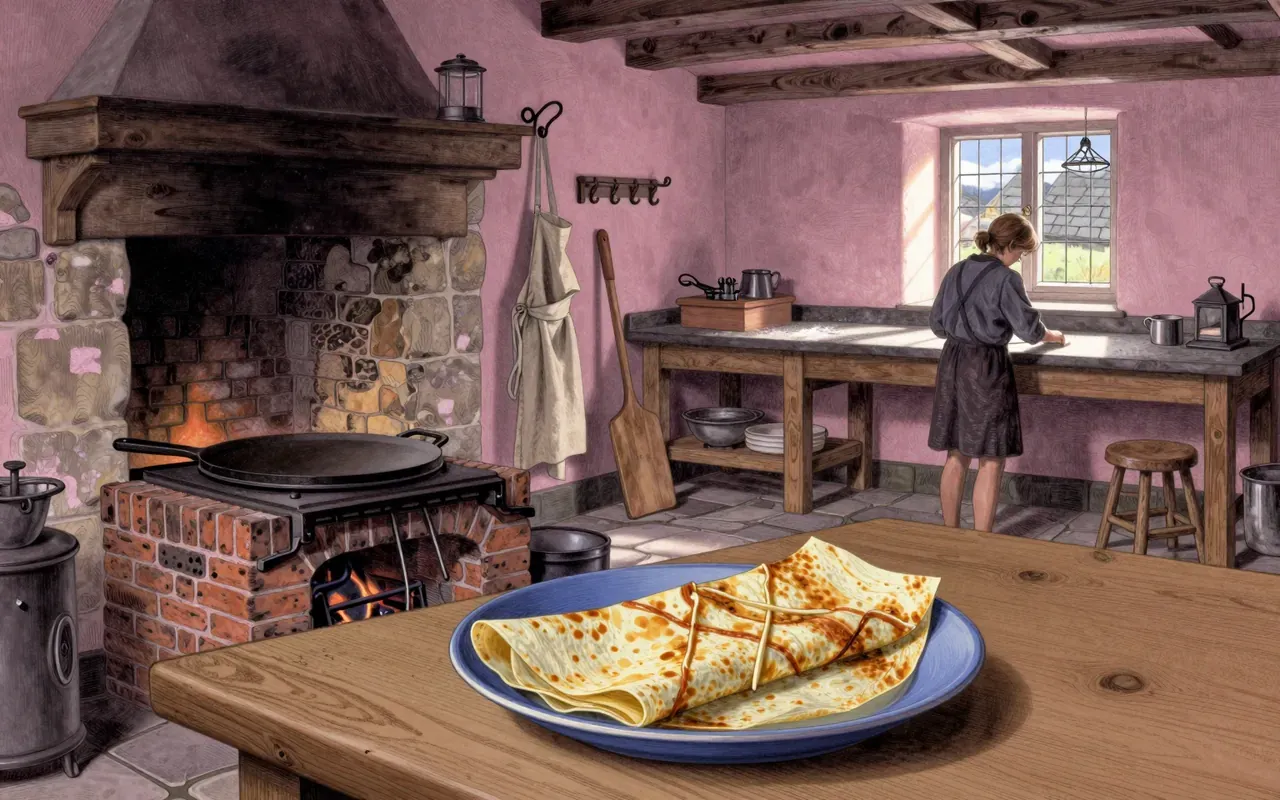
A crêpe is an unleavened batter cooked on a pan or griddle. It is either sweet (crêpe sucrée) or savoury (galette or crêpe salée). It is served with fillings like cheese, fruit, vegetables, meats, or spreads.

Where it came from

Crêpes originated as sacramental bread offered by Pope Gelasius I to French pilgrims in Rome on Candlemas, 2 February 472. The term derives from Latin ‘crispa’, meaning ‘curled’ or ‘wrinkled’.

What it gets right

It establishes a durable, adaptable format: thin, unleavened, griddled. It works for cheese or jam. It survives translation across regions and centuries.

What it gets wrong

Nothing is wrong—but the framing as ‘French’ obscures its origin in a papal sacrament offered to pilgrims in Rome, not Brittany or Paris.

Why it matters now

It persists as a rare unbroken thread from early medieval liturgy to modern street food—proof that ritual can fossilise into cuisine without losing its shape.

Is it worth your time

Yes—if you care about how a simple food ritual encodes theology, geography, and linguistic drift in its wrinkles.
Same course · Dishes4 of 427
9:36
Doubles (food)Doubles is a Trinidadian street food of Indo-Trinidadian origin, created in Princes Town in 1936 by Emamool 'Mamoodeen' Deen and his wife Raheeman Rasulan Deen. It consists of curried chickpeas served on two fried flatbreads called bara. The name 'doubles' came from customers asking to double the bara. It is culturally significant as a symbol of Trinidadian identity, especially among the diaspora, and is credited with defining and maintaining symbolic boundaries of identification in Trinidad's diverse society. Doubles is a comfort food for displaced Trinidadians in major cities across the globe.
12:20
Manchurian (dish)Manchurian is a Mumbai-born Indian-Chinese dish invented in 1975 by Nelson Wang. It uses Indian aromatics (garlic, ginger, green chilli), swaps garam masala for soy sauce, binds with cornstarch, deep-fries, then coats in a soy-based sauce. It delivers crunch, heat and umami—but bears no relation to Manchu or Northeastern Chinese food.
9:38
MuhammaraMuhammara is a red-hued dip originating in Aleppo, Syria, traditionally made with red bell peppers, pomegranate molasses, walnuts, and breadcrumbs, and prepared using a mortar and pestle; it appears in a 1981 encyclopedia and was granted a geographical indication by Turkey in 2022 for Gaziantep.
9:22
Tonkotsu ramenTonkotsu ramen is a pork-bone broth ramen from Kurume, Fukuoka Prefecture, Japan, invented in 1937 by Tokio Miyamoto. Its defining technique is prolonged boiling of pork bones to yield a cloudy, milky broth, and it features culturally distinctive noodle firmness options.
Up next in Food

Croissant

· 8:50

The croissant is not Austrian. It is not ancient. It is a French industrial compromise disguised as tradition.

8:50