Saved
Culture · Dishes

Mofongo

Mofongo isn’t fusion—it’s friction held together by lard and a mahogany mortar.

Worth your time?4/5Yes.Cook the whole thing.What works, what does not, who it is for ↓
9:12in productionCh. 1 · Three Roots, One Mortar/ 9:12 · ceiling 15 min
5 chapters · 9:12Ceiling 15:00

The brief is written and checked. The video joins this page when it is cut.5 chapters · 1 min read · 9:12 planned

Read the brief

Mofongo is a Puerto Rican dish rooted in Taíno, West African, and Spanish traditions. Its earliest written recipe dates to 1859. Core technique requires mashing plantains with fat, spices, and pork in a wooden pilón. Variants like funche criollo prove pork is not essential—but contemporary definitions treat it as such. Frying plantains before mashing became standard by 1948, defining its modern texture. The pilón remains non-substitutable—both tool and cultural anchor.

Chapters & takeaways5
  1. 1:13
    Three Roots, One Mortar

    Mofongo is Puerto Rican—not Caribbean-wide, not Latin American—and its ancestry is threefold: Taíno, West African, Spanish.

  2. 2:12
    1859 Was Already Fully Formed

    The first written mofongo—1859—is already complex: green plantains boiled with veal and hen, mashed with garlic, oregano, ají dulce, bacon or lard, and ham.

  3. 3:23
    Pork Is Not the Rule—It’s the Boundary

    Funche criollo proves pork isn’t essential to the technique—yet mofongo’s definition has hardened around it, sidelining a documented sibling dish.

  4. 4:44
    Fry First, Then Pound

    Frying plantains before mashing—introduced by 1948—became the dominant method, giving mofongo its signature crust and density.

  5. 5:52
    No Pilón, No Mofongo

    The pilón isn’t a tool—it’s a requirement: made of native mahogany or guaiacum, it defines texture, temperature, and cultural continuity.

2 more chaptersFewer chapters
Worth your time?

Yes. Cook the whole thing.

4/ 5
What works
  • El Cocinero Puerto-Riqueño o Formulario (1859)
  • Elizabeth B.K. Dooley’s Puerto Rican cookbook (1948)
What does not
  • iconic
  • groundbreaking
  • timeless
  • seminal
Cook it if
  • people studying food as material culture
  • readers who distrust culinary nationalism
  • cooks who care about technique over trend
Skip it if
  • those seeking origin myths
  • readers who equate popularity with authenticity
Who should cook it, and who should skipHide who it is for
The written brief1 min read

What the thing is

Mofongo is a dense, crusty ball of mashed plantains bound with fat, garlic, and pork, shaped in a wooden pilón and served in broth or alongside stew.

Where it came from

Puerto Rico. Its written form appears in 1859. Its roots are explicitly tripartite: Spain, West Africa, and the Taíno people.

What it gets right

It centres the pilón, pork, and plantain as non-negotiable. It insists on method over ingredient substitution. It holds West African, Taíno, and Spanish lineages as co-present, not layered or sequential.

What it gets wrong

It conflates ‘traditional’ with ‘pork-heavy’, erasing funche criollo—a documented contemporary variant that excludes pork yet shares technique, ingredients, and context.

Why it matters now

Because it demonstrates how a dish can encode resistance—not through symbolism, but through persistent, unyielding technique: the pilón, the lard, the refusal to separate starch from meat, history from heat.

Is it worth your time

Yes—if you want to understand how colonial foodways congeal into national identity, not as myth but as technique, fat, and mortar.
Same course · Culture4 of 156
9:23
KormaKorma is a braised curry rooted in Mughlai court cuisine, defined by yoghurt, slow heat, and aromatic depth—not mildness. Its English name comes directly from the Hindi-Urdu word for 'braising'. First recorded under Shah Alam (1643–1712), it evolved through Persian stew enrichment in the 18th century and appeared as a pilau variant in Hyderabad in 1832. Today it is misread as a generic 'safe' curry, obscuring its technical precision and imperial lineage.
9:44
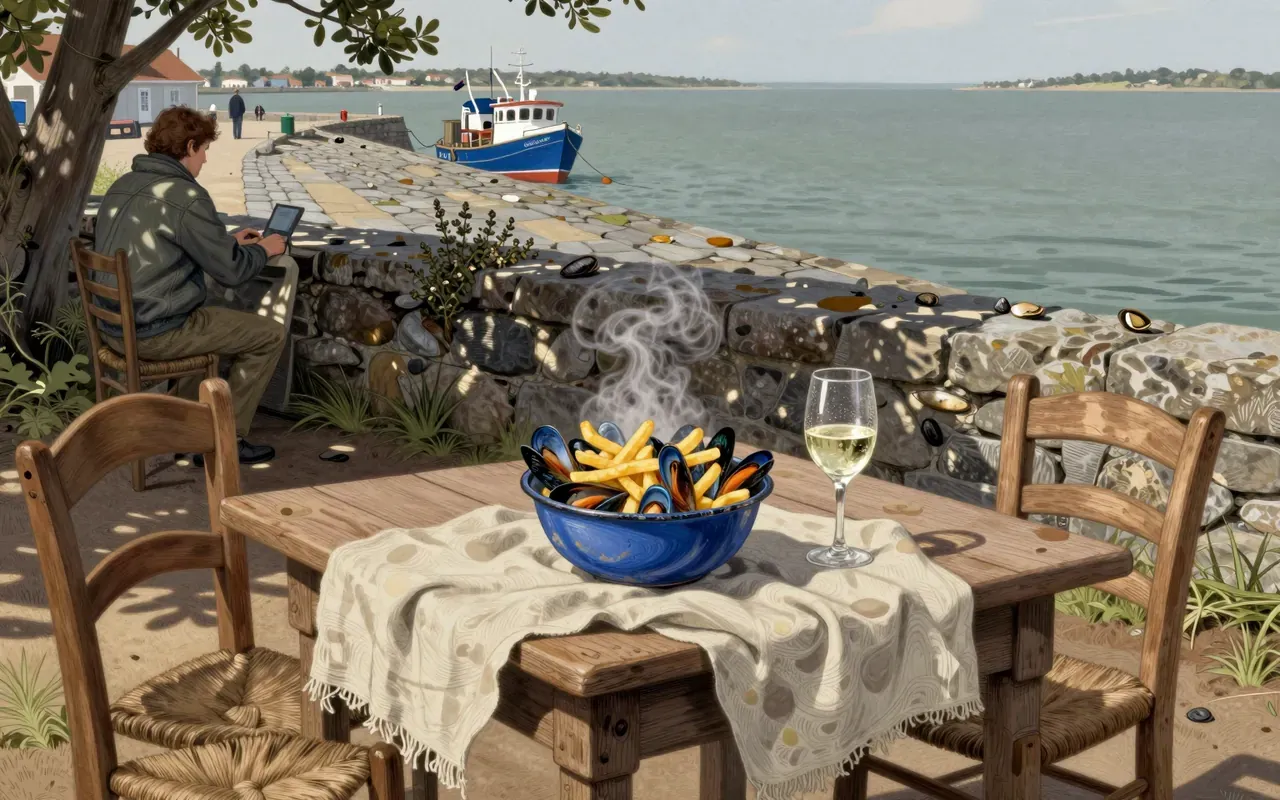
Moules-fritesMoules-frites is a main dish of mussels and French fries. It likely originated in Belgium, combining mussels from the Flemish coast with fried potatoes eaten in winter when other food was scarce. It is Belgium’s national dish. In northern France, it ranks second behind steak-frites (25%). In all of France, it ranks second at 20%. Between 25 and 30 tonnes of mussels are consumed annually in Belgium as moules-frites. During the 2009 braderie of Lille, 500 tons of mussels and 30 tons of fries were consumed.
8:54
Rice and peasRice and peas is a one-pot Creole dish that originated in the Caribbean during the colonial era. Jamaicans first named it. It spread across Central America via enslaved and free Africans, Creoles, and Jamaican labourers between the mid-17th and 20th centuries. Belize’s version traces to both ancient Mayan bean cultivation and later Creole populations formed by British settlers and Jamaican slaves in the late 1700s–1800s.
9:28
FajitaFajitas are a Tex-Mex dish rooted in 1930s South and West Texas ranch culture, built from skirt steak scraps given to vaqueros and cooked over open flame. The term 'fajita' did not appear in print until 1971. Its modern form — adaptable protein, charred vegetables, tortillas, and condiment bar — reflects both ingenuity and erasure: it displaced regional specificity (like 'tacos de arrachera') while becoming a default for 'Mexican-inspired' dining in the US.
Up next in Food

Moin moin

· 1:17

A steamed or boiled bean pudding from Yoruba cuisine, made with peeled beans, onions, peppers, spices, and often fish, eggs, chicken, or crayfish.

1:17