What the thing is
Steak is a culinary category defined by thickness, cooking method, and presentation—not anatomy alone. It includes beef, bison, swordfish, gammon, portobello mushrooms, and reassembled meat.
The plain definition is a cut of meat sliced across the muscle fibres, sometimes including a bone, normally grilled or fried, and sometimes diced or cooked in a sauce. Steaks are most commonly cut from cattle, which gives beefsteak, but also from bison, buffalo, camel, goat, horse, kangaroo, sheep, ostrich, pigs, turkey and deer, and from fish, especially salmon and large fish such as swordfish, shark and marlin. Fish steaks are cut perpendicular to the spine and may include bones. Grilled portobello mushroom may be called mushroom steak, and cauliflower, eggplant, soybeans and watermelon have all been sliced or formed into vegetarian alternatives.
Where it came from
The word entered English from mid-15th-century Scandinavian roots. Its earliest attested use appears in a 15th-century cookbook.
In Middle English it was written steke, from the Scandinavian steik, which is related to the Old Norse steikja, “to roast on a stake”, and so to the words stick and stake. The 15th-century cookbook spells it “stekys” and mentions both beef and venison steaks.
Steak-eating is older than the word. Hunter-gathering peoples cut steaks from local animals: Sami cuisine relies partly on reindeer, the Inuit diet uses sea-mammal meat from whales, Indigenous Australians ate kangaroo, and indigenous North American food included bison steak.
The eating places came later. Chophouses, which served individual portions of meat known as chops, started in London in the 1690s and were normally open only to men; women were admitted to Stone’s Chop House only in 1921. Beefsteak Clubs were once part of London’s club life, and the present-day Beefsteak Club was established in 1876. Delmonico’s in New York City opened in 1827, stayed open for almost 100 years, and has been described as the most famous steak restaurant in American history. Delmonico steak is a style of preparation, applied to one of several beef cuts, typically the rib, originally from the mid-19th century.
What it gets right
It names a functional unit: a slab of food, thick enough to hold structure, thin enough to cook quickly, and shaped for direct heat. It works across species, states (raw, cured, imitation), and kingdoms (fungi, fish, flesh).
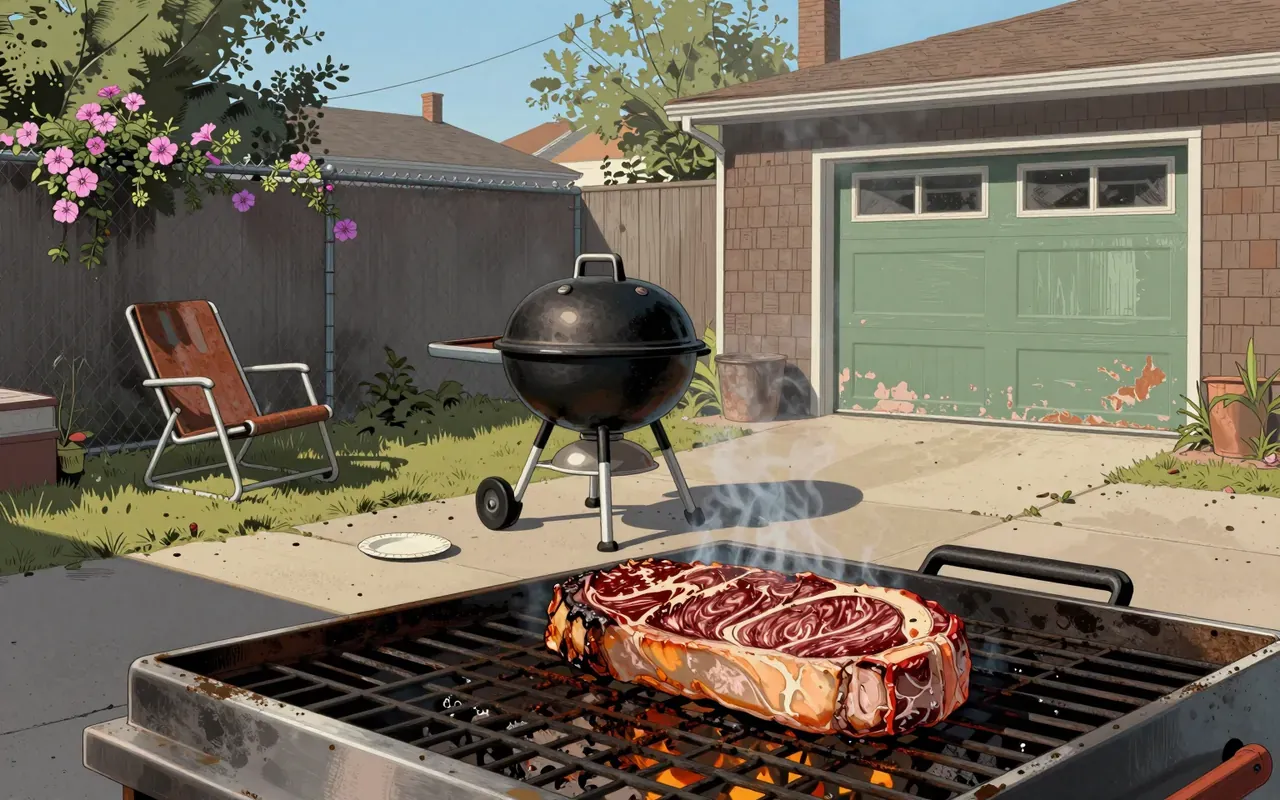
In beefsteak, the more tender cuts from the loin and rib are generally cooked quickly with dry heat and served whole, while the less tender cuts from the chuck or round are generally cooked with moist heat or mechanically tenderized, as in cube steak. Cooking runs from blue, a cold raw centre, through rare, medium rare, medium and medium well to well done, and in restaurants the diner usually specifies it. The outside is usually seared for flavour while the inside is cooked to preference. The aim is to achieve the Maillard reaction on the meat. Beef, unlike some other meats, does not need to be cooked through: food-borne illness is not normally found within a beefsteak, though the surface can be contaminated by handling, so a steak seared outside and raw within is generally accepted as safe.
Fish steaks cook quickly, especially on a grill, though swordfish, halibut, tuna, salmon and mahi-mahi can all be grilled, and tuna can be cooked rare or medium rare. Pork steaks are generally cut from the shoulder, which has a lot of collagen and can be tough without long cooking, so they are often stewed or simmered in barbecue sauce.
The sauces that go with steak are a tradition of their own, including béarnaise, Café de Paris sauce, compound butters such as parsley or garlic butter, demi-glace, peppercorn sauce, mustard, horseradish cream and Worcestershire sauce.
What it gets wrong
It misleads by implying anatomical consistency. Skirt and flank steaks violate the core definition—cut parallel to fibres—not across them. The term privileges presentation over physiology.
A cut named steak in one country is not necessarily the same cut in another, because farming and butchering the carcass differ; the recipes may be the same, differing only in sauces, butters or garnitures. Restructured steak, made from smaller pieces of beef fused with a binding agent, began development in the 1970s, and chicken-fried steak is a breaded, pan-fried cutlet of tenderized cube steak associated with US Southern cuisine, so the name is kept on dishes where the meat is no longer a single slice.
Why it matters now
It reveals how food terminology flattens biological, ethical and industrial complexity into a single, portable, market-ready label—enabling plant-based, lab-grown and reconstituted products to claim continuity with tradition.
The name is now a regulatory question. In 2019 the European Union included steak among protected designations in a revised regulation that passed with 80% approval, designed to protect meat-related terms for edible parts of animals; the decision was to be put to member states and the European Commission. The stated view was that steak should be kept for real steak with meat, and that new non-meat products needed a new name so people know what they are eating.
Beefsteak is also graded and regulated. Australia has National Meat Accreditation standards, Canada has the Canadian Beef Grading Agency and the UK’s Food Standards Agency is responsible there. In the United States young beef is graded Select, Choice or Prime, with Prime the highest, typically with significant marbling; in 1996 only 2.4% of US cattle graded Prime, and most Prime beef is sold in restaurants and hotels. In Argentina, beef steak consumption is described as part of the national identity, steaks over 454 grams (1 lb) are commonplace in restaurants, and asado, often including steak, is considered a national dish.
Is it worth your time
Yes—if you care how language shapes expectation, how cooking methods override anatomy, or how a single word absorbs contradiction without collapsing.