foodbriefs
12:20in productionCh. 1 · Where it began/ 12:20 · ceiling 15 min
Dishes

Bacalhau à Brás

A salt-and-egg binding trick from 19th-century Lisbon that turns three cheap things into something urgent and complete.

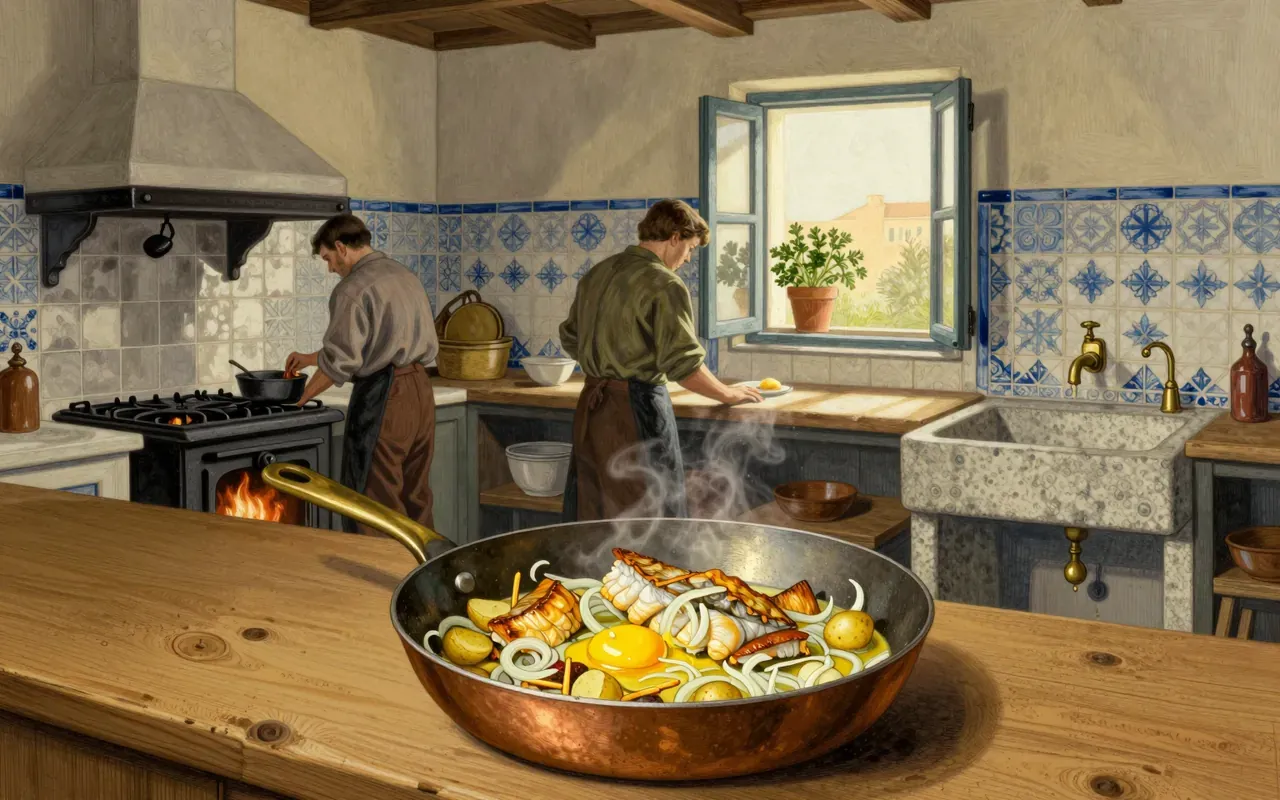
Bacalhau à Brás is a Lisbon dish from the second half of the 19th century. It is shredded salted cod, onions, matchstick-sized fried potatoes, and eggs — bound, not scrambled — and finished with black olives and fresh flat-leaf parsley.

Chapters & takeaways4
  1. 1:00
    Where it began

    It was born in Bairro Alto, Lisbon, in the second half of the 19th century — not earlier, not elsewhere.

  2. 2:27
    How it holds together

    Eggs bind — they do not scramble — and the binding is the technique’s entire point.

  3. 4:13
    How it finishes

    Black olives and flat-leaf parsley are non-negotiable finishers — not optional, not regional variants.

  4. 6:03
    Who gave it its name

    Brás is the name of its creator — not a place, not a family, not a mythic figure.

Worth your time?

Yes. Cook the whole thing.

4.5/ 5
What works
  • The interplay of salty cod, sweet onion, crisp potato, and creamy egg is balanced and immediate.
  • The garnishes — black olives and flat-leaf parsley — add brine and freshness without diluting the core.
What does not
  • It does not hide the saltiness of the cod.
  • It does not work with fresh cod or unsalted fish.
  • It does not tolerate overcooked eggs or soggy potatoes.
Cook it if
  • It is for cooks who want a fast, restaurant-worthy main with pantry staples.
  • It is not for those avoiding salt, eggs, or fried potatoes.
Skip it if
  • It is not for those avoiding salt, eggs, or fried potatoes.
The written brief1 min read

What the dish is and where it came from

Bacalhau à Brás is a Lisbon dish from the second half of the 19th century. It originated in Bairro Alto. It is shredded salted cod, onions, matchstick-sized fried potatoes, and eggs — bound, not scrambled — and finished with black olives and fresh flat-leaf parsley.

How it works, in terms someone would actually use

Shredded salted cod, onions, and matchstick-sized fried potatoes are bound with eggs in a single pan. The eggs must coat without scrambling — a tight, moist, cohesive mass is the goal. Garnish with black olives and fresh flat-leaf parsley.

What it gets right

The interplay of salty cod, sweet onion, crisp potato, and creamy egg is balanced and immediate. The garnishes — black olives and flat-leaf parsley — add brine and freshness without diluting the core.

What it does not

It does not hide the saltiness of the cod. It does not work with fresh cod or unsalted fish. It does not tolerate overcooked eggs or soggy potatoes.

What it changed

It codified a specific binding method — eggs folded into hot, dry, pre-cooked elements — as a distinct Portuguese technique, now named ‘à Brás’.

Who it is for, and who it is not

It is for cooks who want a fast, restaurant-worthy main with pantry staples. It is not for those avoiding salt, eggs, or fried potatoes.

Is it worth your time

Yes — it delivers rich, savoury depth and textural contrast in under 20 minutes. It requires no special equipment or technique beyond controlled heat and timing.

Same course · Dishes4 of 485
9:19
Ackee and saltfishAckee and saltfish is Jamaica’s national dish. It combines ackee—the national fruit, brought from Ghana before 1725—with salted cod introduced for enslaved people as long-lasting protein. It is sautéed, not stewed: boiled ackee meets desalted cod, onions, Scotch bonnet, and tomato. It gets the balance of salt, heat, and creaminess right when timed precisely. It does not reflect West African foodways—where ackee is mostly medicinal—but asserts Jamaican sovereignty over two transplanted staples. Worth your time if you treat it as a technical dish with historical weight, not as folklore.
9:04
AffogatoAffogato is a two-ingredient Italian café dessert from the mid-1900s: gelato—fiordilatte or vanilla—topped with hot espresso. Its name means 'drowned'. It relies entirely on thermal contrast. No inventor is known. English dictionaries first recorded the word in 1988.
8:56
Beef bourguignonBeef bourguignon is a French stew of beef braised in red wine and beef stock, with carrots, onions, garlic, bouquet garni, pearl onions, and mushrooms. It was first documented in 1867. Though associated with Burgundy, it is probably not regional to that area.
11:15
Beef WellingtonBeef Wellington is a baked dish of beef fillet and duxelles wrapped in puff pastry. It appeared in an 1891 Austrian cookbook as Filet à la Wellington, in an 1899 Hamburg-America line menu, and in the US in 1899. Its name is presumed to reference Arthur Wellesley, 1st Duke of Wellington, but the connection is unknown.
Up next in Food

Beef bourguignon

· 8:56

A 19th-century wine-braised stew with no real ties to Burgundy — elevated by reputation, not roots.

8:56