8:53in productionCh. 1 · Venezuelan, not Latin American/ 8:53 · ceiling 15 min
Culture · Dishes
Cachapa
Cachapa is not heritage tourism—it’s 3,000 years of unbroken maize logic.
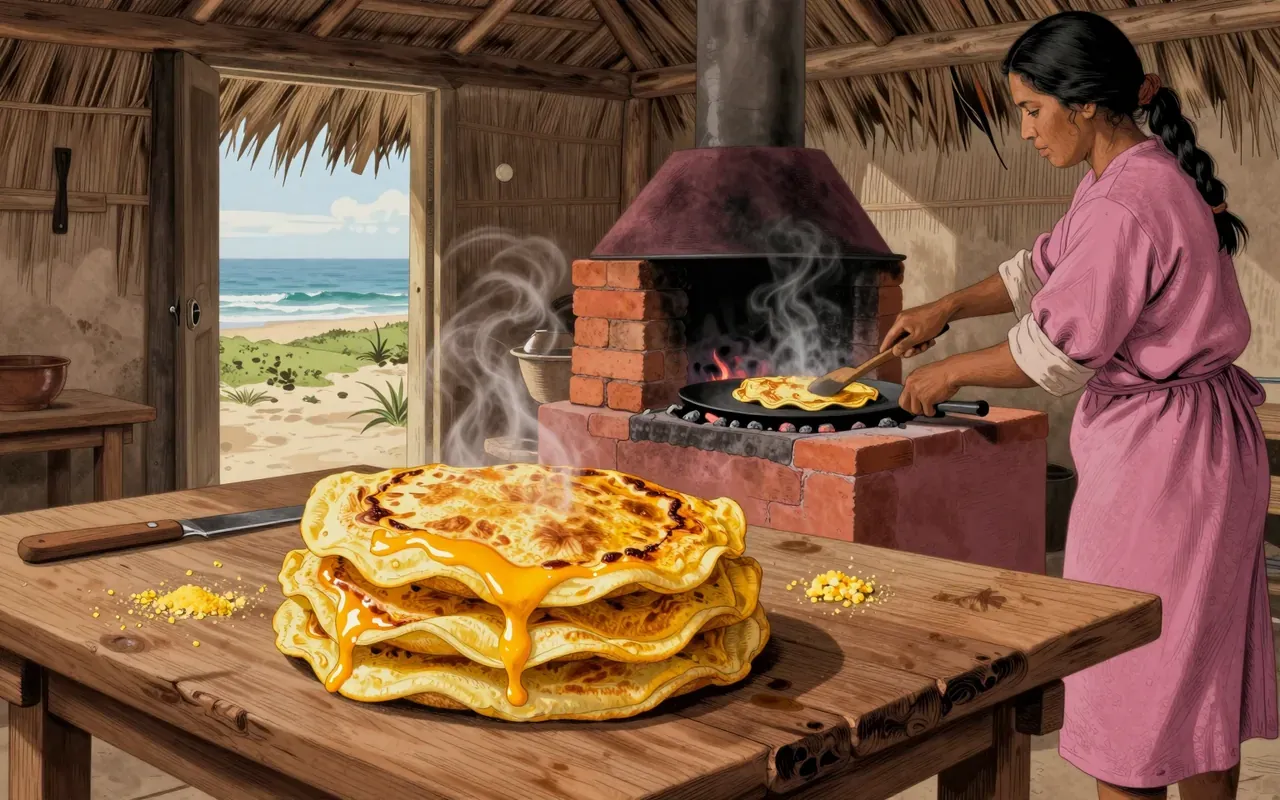
Cachapa is a Venezuelan maize cake with 3,000 years of continuous use. It originates among specific pre-Columbian peoples—not generically ‘indigenous’. It is defined by its pairing with queso de mano and its two preparation methods: griddled or boiled in corn leaves. It makes no claims beyond its own geography and lineage. Its significance lies in its refusal to be abstracted.
Cachapa is Venezuelan. Not regional. Not generic. And it has been eaten there for 3,000 years.
2:24
Pre-Columbian, not mythical
It began with Chaima people—and others: Yanomami, Arawak, Parias—long before colonial borders existed.
4:04
Two methods, one grain
Two forms exist: griddle pancake and boiled-in-corn-leaf. Sweet corn was cultivated for it in north-central Venezuela.
5:21
Cheese is structure, not topping
Queso de mano is non-negotiable. It is soft, fresh, white, handmade—and defines the dish’s texture and balance.
Worth your time?
Yes. Cook the whole thing.
4.5/ 5
What works
as a vessel for continuity
as resistance to culinary amnesia
What does not
claim influence beyond Venezuela
conflate tribes or erase specificity
present as modern innovation
Cook it if
readers who value precision over prestige
people who eat food as history, not flavour
Skip it if
those seeking viral food trends
readers who equate age with exoticism
The written brief1 min read
What the thing is
Cachapa is a maize pancake or boiled leaf-wrapped cake. It is made from fresh corn dough or ground maize. It is eaten with queso de mano.
Where it came from
It originated in Venezuela among pre-Columbian indigenous peoples. The Chaima are most closely associated. Others date it to the Yanomami, Arawak, and Parias between 500 and 1,800 years ago. Anthropological evidence places it in Venezuela for 3,000 years.
What it gets right
It anchors maize to place and time. It honours pre-Columbian technique. It pairs corn with queso de mano—not as garnish but as structural counterpoint.
What it gets wrong
Nothing gets wrong. But it does not claim universality. It is Venezuelan. Not Latin American. Not indigenous broadly. Specific tribes—Chaima, Yanomami, Arawak, Parias—are named. To widen it erases them.
Why it matters now
It resists flattening. In a food media landscape obsessed with fusion and reinvention, cachapa remains unapologetically local, ancient, and unbranded. Its endurance is its argument.
Is it worth your time
Yes—if you care about food as deep cultural continuity, not novelty. It demands no trend justification. It is not for the algorithmically curious.