What the thing is
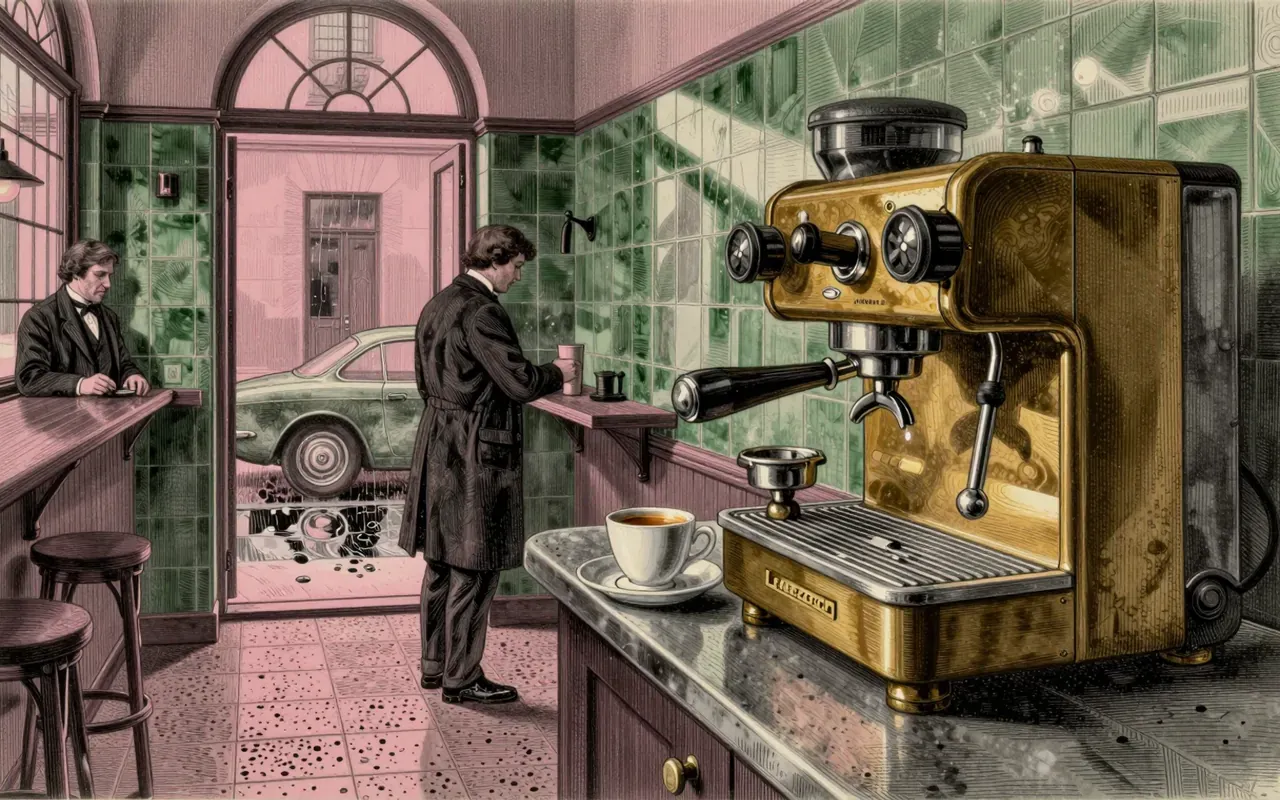
Espresso is a concentrated coffee beverage made by forcing hot water under high pressure through finely ground beans. It yields 25–30 ml in 25–30 seconds. It has crema, high dissolved/suspended solids, and serves as the base for cappuccino, caffè latte, and americano.
Unlike other coffee drinks, espresso has three phases: an emulsion of oil droplets, suspended solids, and a layer of foam. The dispersed oil droplets read as creamy in the mouth and give the drink its body, and they preserve some aromatic compounds that other brewing methods lose to the air. Crema forms when water under very high pressure dissolves more of the carbon dioxide produced during roasting.
Where it came from
It originated in Italy. The first relevant patent was filed in 1884 by Moriondo.
Moriondo’s machine brewed in bulk, not in single servings. The single-serving machine came in 1901, when Luigi Bezzera of Milan filed a patent for a boiler-fed machine with a portafilter, making coffee ‘expressly’ for the customer. Desiderio Pavoni bought his patents in 1903 and began selling machines in 1905. These ran at around 1.5 bars, too little to make what is now called espresso, and gave no crema; drinks took almost a minute and tasted burnt and bitter. Achille Gaggia’s piston machines, on sale from 1948, pushed water at up to 12 atmospheres and are typically seen as the first modern espresso machines. In 1961 the Faema E61 used an electric pump, run from an on-off switch, to pressurise water to 9 bars.
What it gets right
It delivers intense, reproducible coffee in under thirty seconds. It creates crema. It concentrates flavour and body via suspended solids. It functions reliably as a base for layered drinks.
A single, double or triple uses roughly 7, 14 or 21 grams of ground coffee. For a double, a normale uses about 60 ml of water and a double ristretto about 30 ml; the grind is adjusted, finer for ristretto and coarser for lungo, so the shots may not simply be the same espresso stopped at different times.
What it gets wrong
It misleads on caffeine: higher concentration per ml does not mean more caffeine per serving. Its narrow technical definition excludes variation that matters to drinkers—e.g., regional Italian preparations outside the 25–30 ml norm.
A typical 30 ml serving holds approximately 65 mg of caffeine; a typical 240 ml serving of drip coffee holds approximately 95 mg.
Why it matters now
It remains the operational core of global coffee service—not because it tastes universally preferred, but because its constraints standardise labour, volume, and timing across cafés, chains, and homes.
Is it worth your time
Yes—if you care how a beverage’s physics shapes daily ritual. It is not a lifestyle choice. It is a precise, repeatable extraction method with strict parameters.