What the dish is and where it came from
Consommé is a type of clear soup made from richly flavoured stock or broth that has been clarified. It is most commonly made from beef or veal, though chicken, fish and game variants are recognised in French cuisine. It can be served on its own, hot or chilled, or used as the basis of many soups, sauces and stews.
The French word dates to the fourteenth century, as the past participle of consommer, meaning consumed, accomplished or finished. By the sixteenth century it was a noun for a finished soup: a concentrated, clarified meat broth, as opposed to a simple stock. The first edition of the Dictionnaire de l’Académie française in 1694 defines it as a strong, succulent broth of very well-cooked meat. English first records the word in 1815, and Byron lists the consommé alongside the salmi and the purée in Don Juan.
How it works, in terms someone would actually use
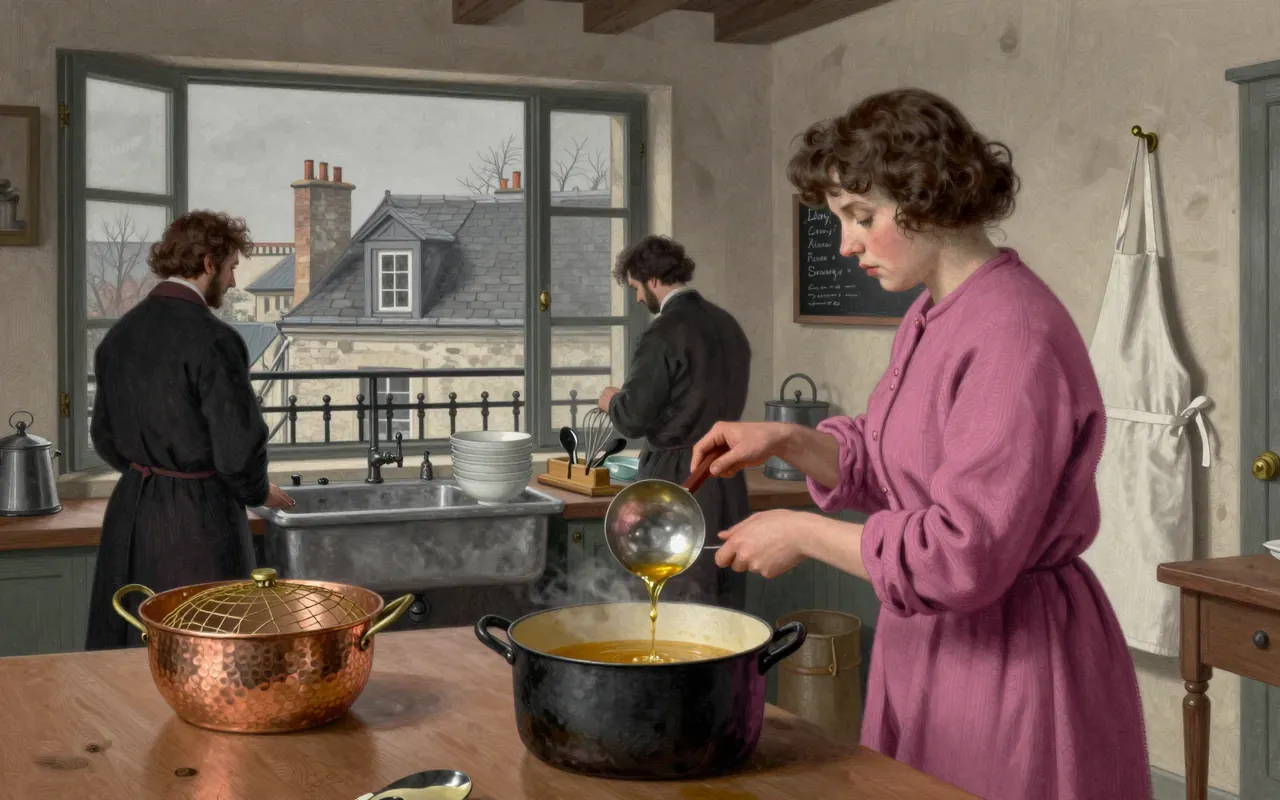
Clarification is the step that makes it a consommé. Traditionally egg whites remove fat and sediment from the stock. A later technique uses gelatin filtration, which Harold McGee described in a 2007 New York Times article and which began among chefs of the molecular gastronomy movement. It relies on a super-saturated solution of gelatin, created by freezing, to remove the particles that make a stock cloudy.
The two methods give different results. A traditional consommé is rich in gelatin, with a correspondingly rich mouthfeel, and it gels when chilled. A gelatin-filtered broth is free of gelatin and does not gel. A double consommé is made to double strength, either by doubling the meat or by reducing a normal consommé to half its volume.
What it gets right
It works as a base. Alexis Soyer published his recipe in The Gastronomic Regenerator in 1846 and uses consommé in more than a hundred recipes, from demi-glace to Macaroni à la Napolitaine. Escoffier likewise uses it for many soups, sauces and stews as well as serving it on its own.
It also stands without a garnish. Escoffier says suppers served consommés only in cups, hot or cold, so they had to be perfect in themselves, delicate and quite clear.
What it does not
Escoffier’s supper consommés, served only in cups, took no garnish because they were drunk at table. His garnished consommés were for dinners, served in soup plates.
What is advertised as beef consommé is also sold in cans. A proprietary British brand on sale in 2025 listed water, sherry at 3%, beef gelatin, yeast extract and beef extract at 0.2%, among other ingredients, and a US brand listed monosodium glutamate and caramel colour. Simone Beck, Louisette Bertholle and Julia Child state in Mastering the Art of French Cooking (1961) that they do not recommend tinned consommé.
What it changed
Consommé has many named variants. In Le Répertoire de la cuisine (1914), Louis Saulnier gives recipes for more than a hundred variants. They include parisienne, a beef consommé with leeks, Rossini, a chicken consommé with truffles and foie gras, and Rothschild, a game consommé with Sauternes.
Who it is for, and who it is not
It is for cooks who want a clear soup to serve alone, or a clarified base for soups, sauces and stews. It is not for anyone planning to buy it tinned, which Beck, Bertholle and Child do not recommend.
Is it worth your time
Yes, if you cook. A clarified broth is a soup to drink and a base for other dishes, and the two clarification methods give you a choice between a gelatin-rich result that gels when chilled and a gelatin-free one.