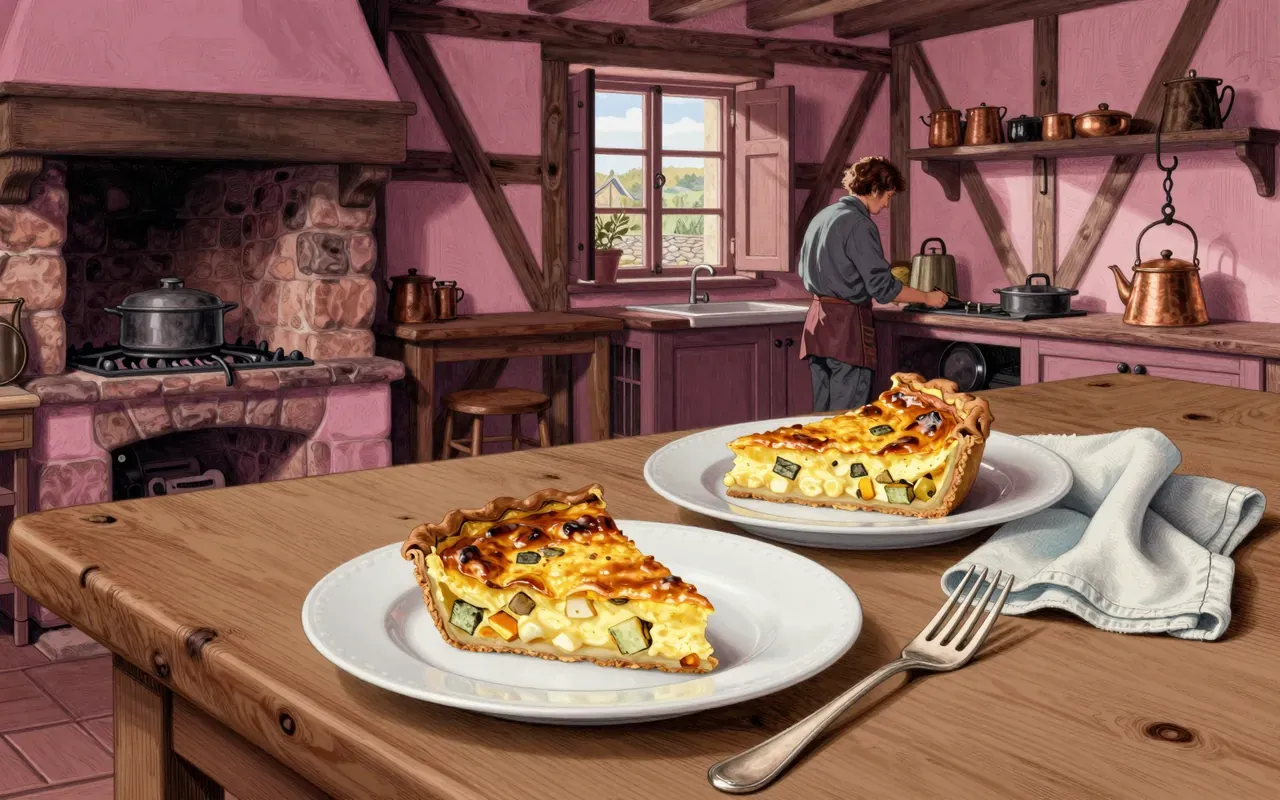
It is defined by three ingredients: eggs, thick cream, and bacon—bound into a savoury custard.
1:52
Where it began
It began in Lorraine in the 16th century—not as haute cuisine, but as local fare.
3:24
What got lost
Its original form used bread dough and was served on May Day—neither survives in the mainstream version.
4:48
When it went national
It stayed regional until the mid-20th century—then spread without consensus on what counted as real.
Worth your time?
Yes. Cook the whole thing.
3.5/ 5
What works
as a case study in cultural translation
as proof that tradition is often a late edit
What does not
claims influence beyond source
invents dates or people
uses filler language
confuses popularity with significance
Cook it if
readers tracking how food acquires authority
cooks interrogating recipe orthodoxy
historians of everyday life
Skip it if
those seeking culinary nostalgia
people who treat 'authenticity' as self-evident
readers wanting technical instruction
The written brief1 min read
What the thing is
Quiche Lorraine is a savoury French tart with an open pastry case filled with a custard of eggs, thick cream, and bacon or ham.
Where it came from
It originated in the eastern French region Lorraine in the 16th century. Its name may derive from the German word Kuchen.
What it gets right
It delivers a rich, savoury custard in a crisp case. The balance of eggs, cream, and bacon is functional and stable. It anchors a meal without demanding attention.
What it gets wrong
It pretends to be fixed. The bread-dough case was replaced. Cheese was added. May Day service disappeared. Its ‘tradition’ is a mid-20th-century consolidation, not a continuous line.
Why it matters now
It exposes how food becomes legible through erasure: regional obscurity, seasonal ritual, and structural variation all vanished as it scaled—leaving only a branded shell of ‘Frenchness’.
Is it worth your time
Yes—if you care about how regional dishes become national symbols, and why authenticity claims harden long after a dish has left home.