8:48in productionCh. 1 · What it is/ 8:48 · ceiling 15 min
Culture · Dishes
Gumbo
Gumbo is not a symbol of unity—it’s evidence of what held together under pressure.
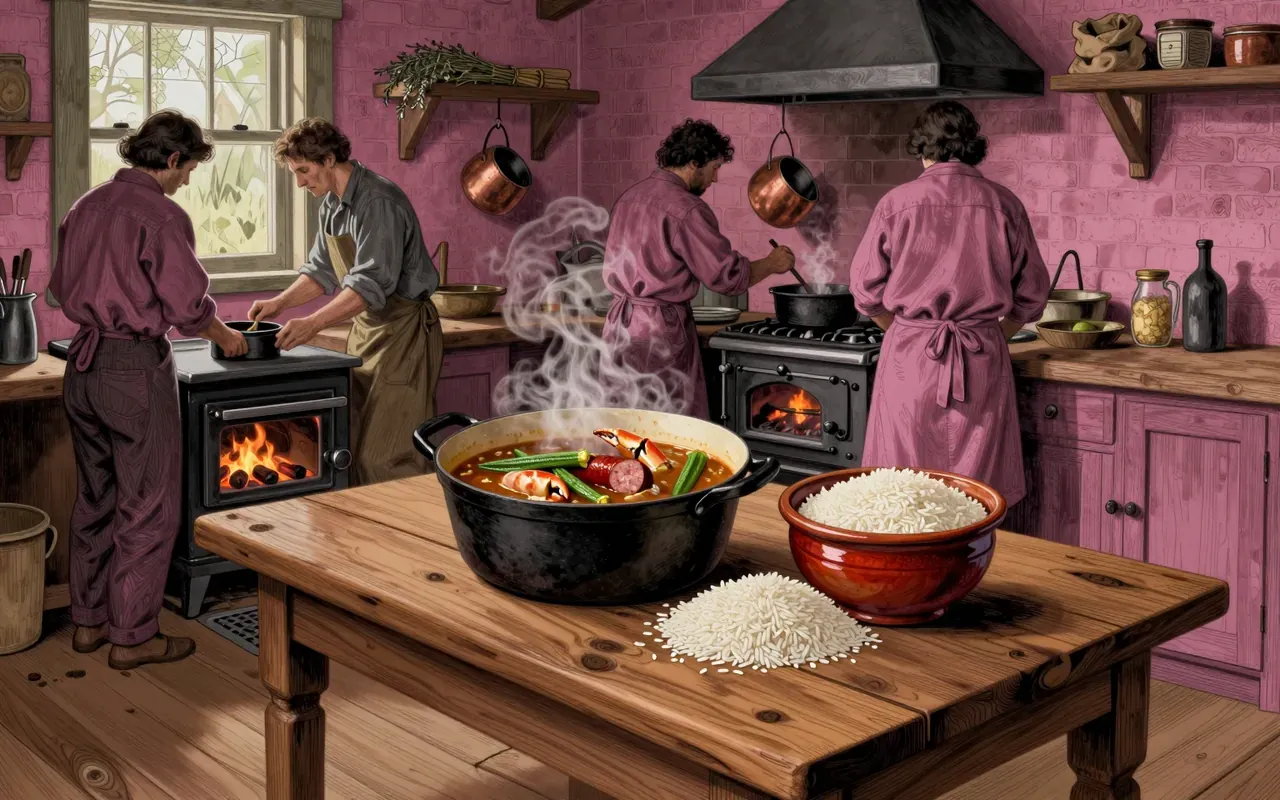
Gumbo is a stew from the U.S. Gulf Coast. It is defined by stock, meat or shellfish, the Creole 'holy trinity', and one of three thickeners: okra, filé powder, or roux. It originated in Louisiana in the early 18th century. It combines culinary practices from Central and West African, French, German, Spanish, and Native American Choctaw cultures. It was first described in 1802. It is traditionally served with rice. It simmers for a minimum of three hours, with shellfish and some spices added near the end. The preferred method in the historical New Orleans variation is with a French-inspired dark, even chocolate-like, roux. Gumbo is often categorized by the type of thickener used, whether okra or filé powder.
Gumbo is a Gulf Coast stew served with rice—and Louisiana’s official state cuisine.
2:19
Where it came from
It emerged in early 18th-century Louisiana from Central and West African, French, German, Spanish, and Choctaw practices—and was first written down in 1802.
3:47
How it works
Its structure—trinity, stock, protein, thickener—forces specificity: each thickener signals a different origin and logic.
5:17
The time it takes
It requires at least three hours of simmering, with shellfish added late—a rhythm shaped by availability, not convenience.
Worth your time?
Yes. Cook the whole thing.
4.5/ 5
What works
as documentation
as resistance to erasure
as a model of constrained improvisation
What does not
iconic
groundbreaking
seminal
Cook it if
cooks
historians of everyday life
students of forced cultural exchange
Skip it if
those seeking culinary novelty
fans of rapid recipes
readers who conflate longevity with consensus
The written brief1 min read
What the thing is
Gumbo is a stew from the U.S. Gulf Coast. It is defined by stock, meat or shellfish, the Creole ‘holy trinity’, and one of three thickeners: okra, filé powder, or roux.
Where it came from
It originated in Louisiana in the early 18th century. It combines culinary practices from Central and West African, French, German, Spanish, and Native American Choctaw cultures.
What it gets right
It honours layered cultural cohabitation without flattening it into fusion. The trinity, the roux, the okra, the filé—each thickener anchors a distinct lineage. It demands time: three hours minimum. It insists on rice as vessel, not garnish.
What it gets wrong
It obscures hierarchy. The French-inspired dark roux is named ‘preferred’ in New Orleans—but the sources do not say who preferred it, or when that preference became dominant. Okra and filé are presented as alternatives, not as practices with unequal access, suppression, or erasure.
Why it matters now
Because it is a documented site of uncredited synthesis—where colonial power, Indigenous knowledge, and enslaved expertise converged in daily practice, not theory. Its persistence contradicts the myth that cultural mixing requires permission.
Is it worth your time
Yes—if you care how food encodes survival, negotiation, and refusal in a single pot.