What the thing is
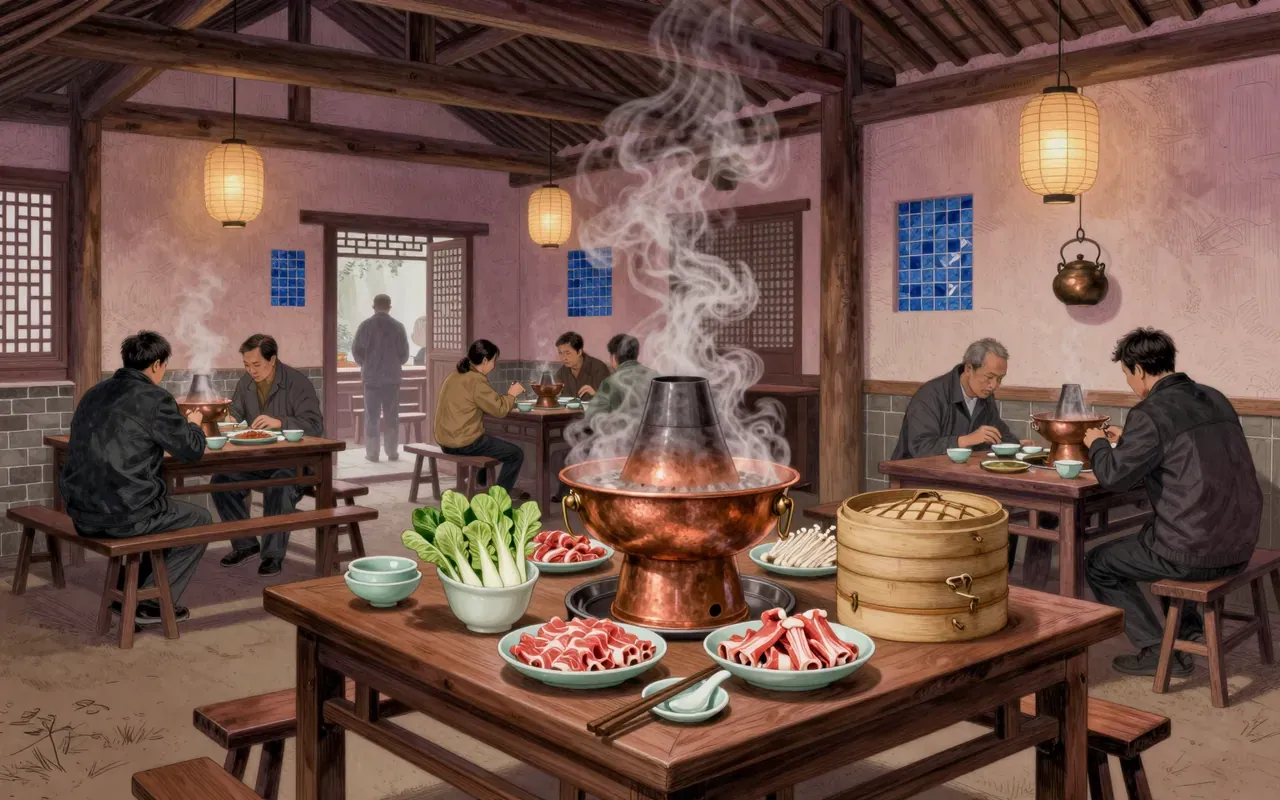
Hot pot is a table-side cooking method: a simmering broth, raw thinly sliced ingredients, and dipping sauces. Cooked by brief immersion. Served communally.
Hot pot, also called steamboat, is huǒguō in Chinese, literally ‘fire pot’. It is considered a main course and may be served without rice or noodles. Typical ingredients are thinly sliced mutton or beef, leaf vegetables, mushrooms, vermicelli, tofu and seafood, and the food dipped in the pot adds flavour to the broth in turn.
Where it came from
Tripods of the Zhou dynasty are its earliest prototypes. A copper hot pot from the Three Kingdoms period (200–280 AD) is generally acknowledged as its origin.
Diners among the nobility each had a personal bronze pot called a ran lu, a small stove with a small pot above burning charcoal. In the Qing dynasty the Qianlong Emperor was very fond of hot pot and ate it at almost every meal, and the Jiaqing Emperor held a coronation banquet with 1,550 hot pots.
What it gets right
It makes cooking a shared act. Everyone controls their own immersion time. Everyone chooses their sauce. No chef stands between diner and dish.
Regional styles differ. In general, southern Chinese styles have spicy broths and complex dipping sauces and lean on seafood, vegetables and mushrooms, while northern styles are simpler and focus on meat, particularly mutton. Chongqing hot pot uses mala seasoning of chili and Sichuan pepper, with a typical dipping sauce of sesame oil, crushed fresh garlic and chopped spring onions. Chaoshan beef hot pot is distinguished by its clear broth, usually made from beef bones. One Cantonese variation mixes a raw egg with the condiments to reduce the ‘heat’ absorbed by the food, according to Chinese herbalist theories.
What it gets wrong
It assumes uniform heat and timing across all ingredients—yet raw foods demand individualised immersion durations, and the broth’s gentle boil cannot accommodate divergent needs without vigilance or error.
Why it matters now
It resists the professionalisation and atomisation of eating. In an era of meal kits and algorithmic menus, it insists on real-time, collective decision-making at the table.
In many regions outside Asia, hot pot is commonly eaten at home or in restaurants on small portable stoves at the table, such as butane gas stoves, induction hobs or electric hot plates, which provide a stable simmer through the meal. Switzerland has its own version, fondue chinoise, a popular Christmas meal.
Is it worth your time
Yes—if you care about food as social infrastructure, not just flavour.