10:19in productionCh. 1 · Origin: Creole, not colonial/ 10:19 · ceiling 15 min
Street food · Dishes
Jamaican patty
A Jamaican patty is not fusion—it’s Creole: built by folding dough, not by blending cultures.
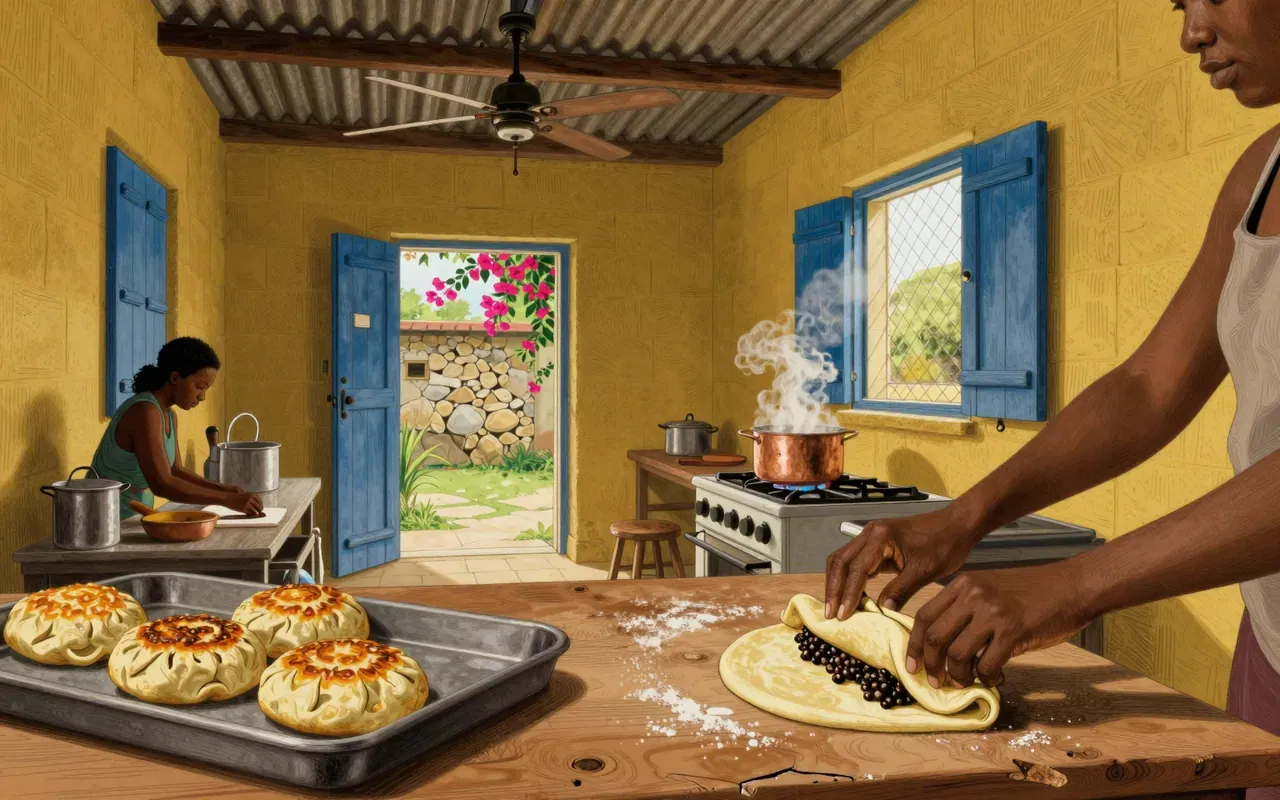
A Jamaican patty is a semicircular, flaky, golden-yellow baked turnover formed by folding a circular dough cutout over spiced ground beef. It originated in Jamaica as a Creole dish shaped by British, Spanish, African, Chinese, Indian and Indigenous Arawak traditions—not as a copy of the Cornish pasty or Spanish empanada, but as a local response to available ingredients and techniques. Its folded structure works: it contains juicy, spiced filling without leakage. It falls short as a vehicle for delicate or vegetarian preparations—the method demands robustness. It changed how street food functions in Jamaica and abroad, becoming affordable daily fuel first, then a branded export. It is for eaters who value portability, spice and cultural specificity—not for those seeking lightness, purity or neutrality. It is worth your time if you want to taste a dish whose form and history are inseparable.
It is a Jamaican Creole dish—not an import or adaptation, but a local synthesis.
3:02
Form: Folded, baked, sealed
Its shape and bake define its function: folded circle, flaky shell, golden-yellow crust.
4:40
Scale: From Kingston stalls to national chains
By the 1930s it was street food; by the 1960s, commercial franchises scaled it across Jamaica.
6:14
Diaspora: Carried north by nurses and aides
Jamaican healthcare workers carried patty recipes to the US in the 1960s and 1970s—spreading it as lived practice, not marketing.
Worth your time?
Yes. Cook the whole thing.
4.5/ 5
What works
It gets right the balance of flakiness and structural integrity: the folded circular dough holds robust fillings without leaking during baking.
What does not
It does not claim singular origin—it is a Creole dish, not a direct descendant of one tradition.
Cook it if
It is for people who want fast, spiced, handheld meat pastry—not for those seeking minimalist, ingredient-led or low-fat fare.
Skip it if
It is not for those seeking minimalist, ingredient-led or low-fat fare.
The written brief1 min read
What the dish is and where it came from
It is a semicircular, flaky, golden-yellow baked turnover from Jamaica, a Creole dish influenced by Cornish pasties and Spanish empanadas.
How it works, in terms someone would actually use
It is a baked turnover: a circular dough cutout folded over filling, then sealed and baked until flaky and golden-yellow.
What it gets right
It gets right the balance of flakiness and structural integrity: the folded circular dough holds robust fillings without leaking during baking.
What it does not
It does not claim singular origin—it is a Creole dish, not a direct descendant of one tradition.
What it changed
It changed street food culture in Jamaica by the 1930s, then diaspora food systems in North America and Britain through commercial bakeries and supermarket distribution.
Who it is for, and who it is not
It is for people who want fast, spiced, handheld meat pastry—not for those seeking minimalist, ingredient-led or low-fat fare.
Is it worth your time
Yes—if you want a portable, savoury, spiced meat pastry with clear regional roots and global reach.