foodbriefs
9:31in productionCh. 1 · Oldest confirmed users/ 9:31 · ceiling 15 min
Dishes · Traditions

Tamale

Tamales weren’t snacks. They were sacred rations—and the first food designed for empire.

Tamales are not a dish. They are a 10,000-year-old technology for sustaining human organisation—ritual, military, migratory—rooted in corn’s theological status. Their continuity is structural, not culinary.

Chapters & takeaways4
  1. 0:56
    Oldest confirmed users

    Tamales predate written history in Mesoamerica—and the Toltecs are the oldest confirmed users.

  2. 3:00
    Ritual and logistics

    They appear in 2,000-year-old murals—and powered armies, hunts, and long-distance travel.

  3. 4:28
    Sacred food of the gods

    Corn was divine. So tamales weren’t food—they were edible theology.

  4. 5:35
    Indigenous infrastructure

    Their spread wasn’t colonial—it was indigenous diffusion across the Americas.

Worth your time?

Yes. Cook the whole thing.

4.5/ 5
What works
  • as a corrective to ahistorical food writing
  • as evidence of Indigenous logistical sophistication
What does not
  • claim influence beyond what the sources state
  • treat popularity as significance
  • confuse contemporary resonance with historical function
Cook it if
  • readers who track how food enables power
  • those tired of culinary nostalgia without archaeology
Skip it if
  • readers seeking recipes or modern fusion
  • those expecting colonial-era transmission narratives
The written brief1 min read

What the thing is

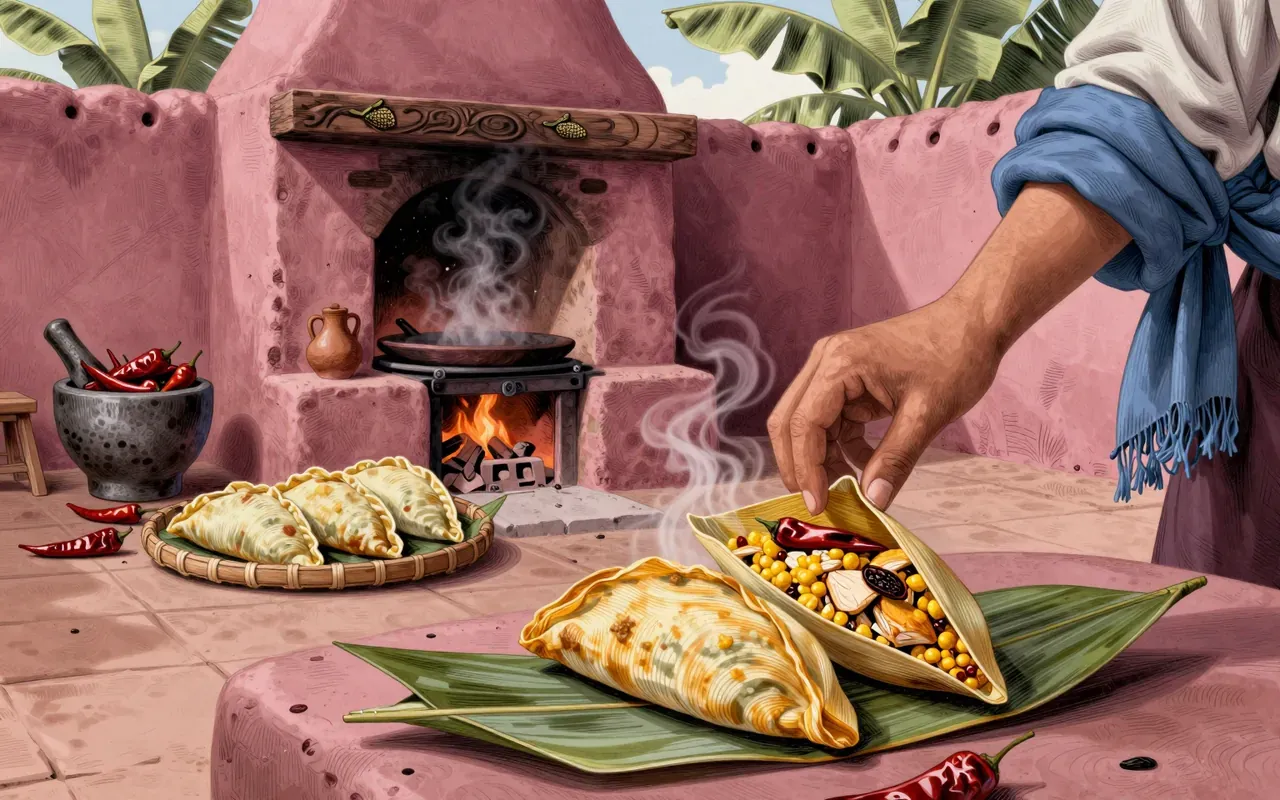
A steamed maize dough parcel, wrapped in corn husk or banana leaf, containing savoury or sweet fillings.

Where it came from

Mesoamerica, between 8000 and 5000 BC. Confirmed use by the Toltecs (250 BCE–750 CE) at Teotihuacan; pictorial evidence from ~100 AD in San Bartolo, Guatemala.

What it gets right

Tamales encode corn’s sacred centrality in Mesoamerican cosmology. They were portable ritual objects—fed to armies, carried on hunts, offered to gods. Their form is function: steamed in husks, sealed for travel and ceremony alike.

What it gets wrong

Nothing in the sources supports claims of tamale ‘influence’ beyond indigenous diffusion. It does not establish global reach, adaptation, or modern reinvention—only pre-Columbian use and spread across the Americas via indigenous networks.

Why it matters now

It disrupts the myth that ancient foods are static or folkloric. Tamales were state-scale logistics tools—ritual, military, and nutritional—long before ‘street food’ or ‘artisanal’ entered the lexicon.

Is it worth your time

Yes—if you care about food as cultural infrastructure, not just flavour.
Same course · Dishes4 of 427
9:36
Doubles (food)Doubles is a Trinidadian street food of Indo-Trinidadian origin, created in Princes Town in 1936 by Emamool 'Mamoodeen' Deen and his wife Raheeman Rasulan Deen. It consists of curried chickpeas served on two fried flatbreads called bara. The name 'doubles' came from customers asking to double the bara. It is culturally significant as a symbol of Trinidadian identity, especially among the diaspora, and is credited with defining and maintaining symbolic boundaries of identification in Trinidad's diverse society. Doubles is a comfort food for displaced Trinidadians in major cities across the globe.
12:20
Manchurian (dish)Manchurian is a Mumbai-born Indian-Chinese dish invented in 1975 by Nelson Wang. It uses Indian aromatics (garlic, ginger, green chilli), swaps garam masala for soy sauce, binds with cornstarch, deep-fries, then coats in a soy-based sauce. It delivers crunch, heat and umami—but bears no relation to Manchu or Northeastern Chinese food.
9:38
MuhammaraMuhammara is a red-hued dip originating in Aleppo, Syria, traditionally made with red bell peppers, pomegranate molasses, walnuts, and breadcrumbs, and prepared using a mortar and pestle; it appears in a 1981 encyclopedia and was granted a geographical indication by Turkey in 2022 for Gaziantep.
9:22
Tonkotsu ramenTonkotsu ramen is a pork-bone broth ramen from Kurume, Fukuoka Prefecture, Japan, invented in 1937 by Tokio Miyamoto. Its defining technique is prolonged boiling of pork bones to yield a cloudy, milky broth, and it features culturally distinctive noodle firmness options.
Up next in Food

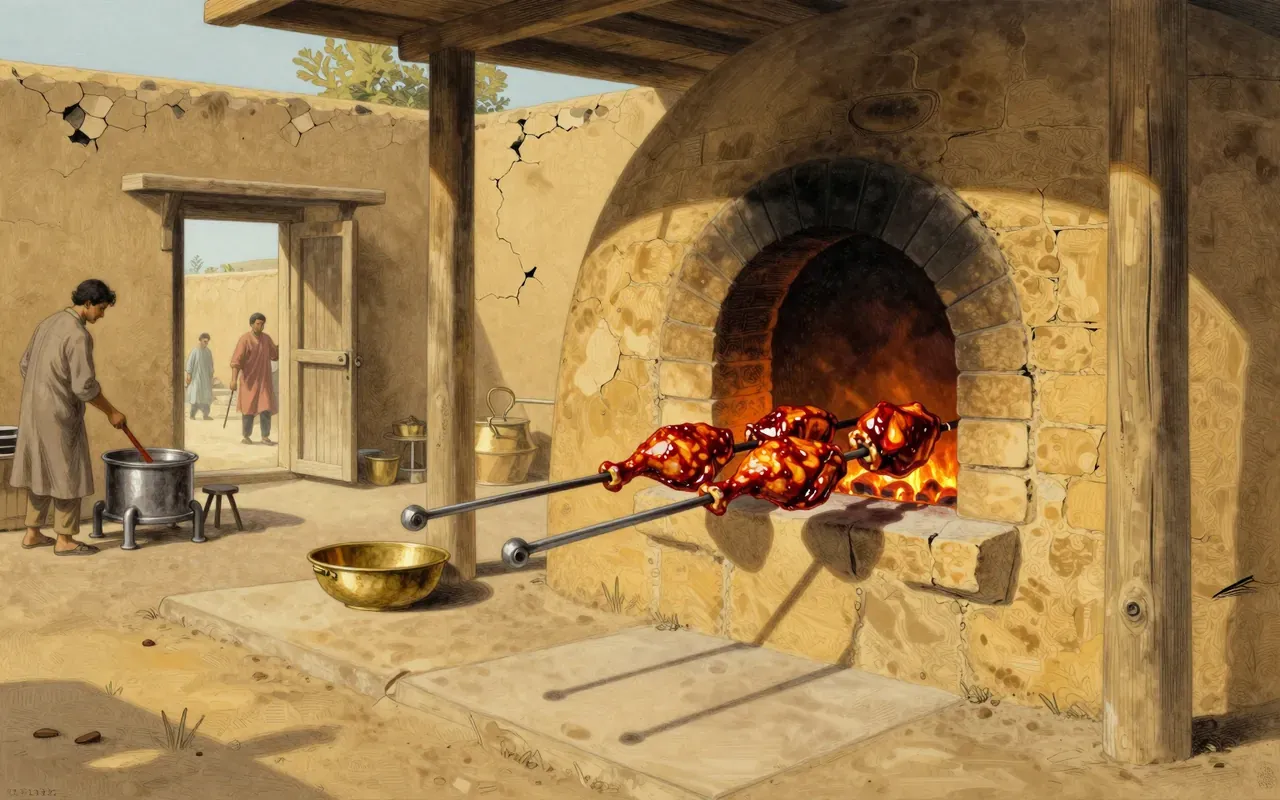
Tandoori chicken

· 0:58

Chicken marinated in yogurt and spices, then roasted in a cylindrical clay oven.

0:58