What the thing is
Vanilla is a spice made from cured seed pods of V. planifolia, an orchid native to Mexico and Central America.
Three species are grown globally, all derived from one originally found in Mesoamerica: V. planifolia, grown on Madagascar, Réunion and other tropical areas along the Indian Ocean; V. × tahitensis, grown in the South Pacific; and V. pompona, found in the West Indies, Central America and South America. Most of the world’s vanilla is V. planifolia, known as Bourbon or Madagascar vanilla, and Madagascar and Indonesia together produce two-thirds of the supply. By weight it is the second-most expensive spice after saffron, because growing the pods is labor-intensive.
Where it came from
Domesticated by the Totonac people of Mexico by at least 1185. First flowered in Europe—in London—in 1806.
The Totonac used vanilla as a fragrance in temples and as a good-luck charm in amulets, as well as to flavour food and drink. The Aztecs invaded the Totonacs in 1427, developed a taste for the pods and mixed vanilla with cocoa in a drink called xocolatl. Hernán Cortés is credited with introducing both vanilla and chocolate to Europe in the 1520s.
What it gets right
It delivers a globally traded flavour from a finicky orchid that cannot self-pollinate. Hand-pollination works reliably. It scales.
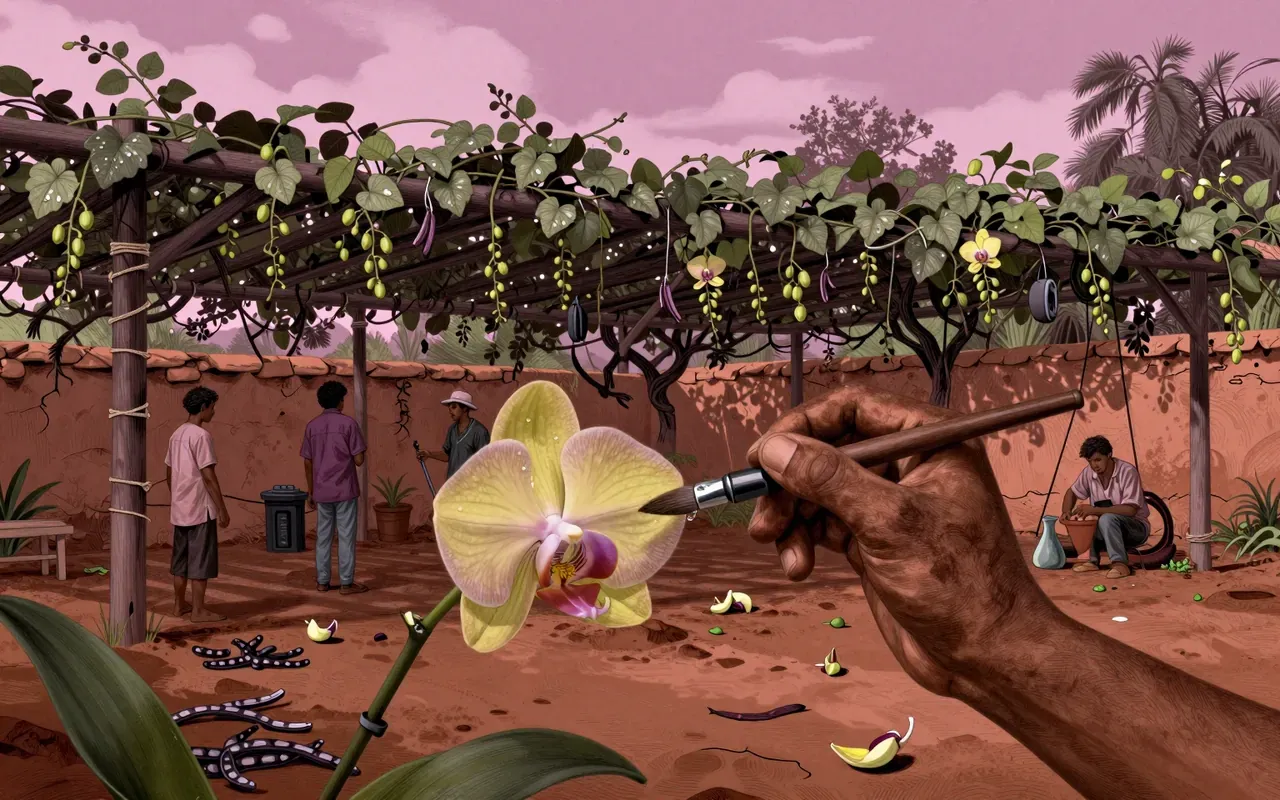
The method is simple. Using a beveled sliver of bamboo, a worker lifts the membrane that separates the anther from the stigma, then uses a thumb to press the pollen mass from one to the other. The flower then produces a fruit. A V. planifolia flower lasts about a day, sometimes less, so growers must inspect their plantations every day for open blooms.
What it gets wrong
It pretends to be natural. Natural pollination is rare and inefficient. The vanilla industry runs on human labour—not bees, not wind, not luck.
The record of who found the method is not tidy. The Belgian botanist Charles Morren discovered in 1837 that vanilla is not autogamous and tried artificial pollination, but his method proved financially unworkable and was never used commercially. The French botanist Jean Michel Claude Richard falsely claimed to have found the technique three or four years before Edmond Albius did in 1841. By the end of the 20th century, Albius was considered the true discoverer.
Why it matters now
Vanilla exposes the hidden labour behind ‘natural’ food: a crop dependent on hand-pollination since 1841, pioneered by a 12-year-old enslaved boy on Réunion.
Once Albius’s method was known, the pods began to thrive on Réunion, and the orchids were sent on to the Comoros, Seychelles and Madagascar with instructions for pollinating them. By 1898 Madagascar, Réunion and the Comoros produced 200 metric tons of vanilla beans, about 80% of world production that year. Mexico had been the chief producer until the mid-19th century. An estimated 95% of “vanilla” products are flavoured with vanillin derived from lignin rather than from the vanilla fruit.
Is it worth your time
Yes—if you care how colonial botany, enslaved ingenuity, and insect scarcity shape what’s in your pantry.