foodbriefs
9:10in productionCh. 1 · Not a breed. Four breeds./ 9:10 · ceiling 15 min
Dishes · Food history

Wagyu

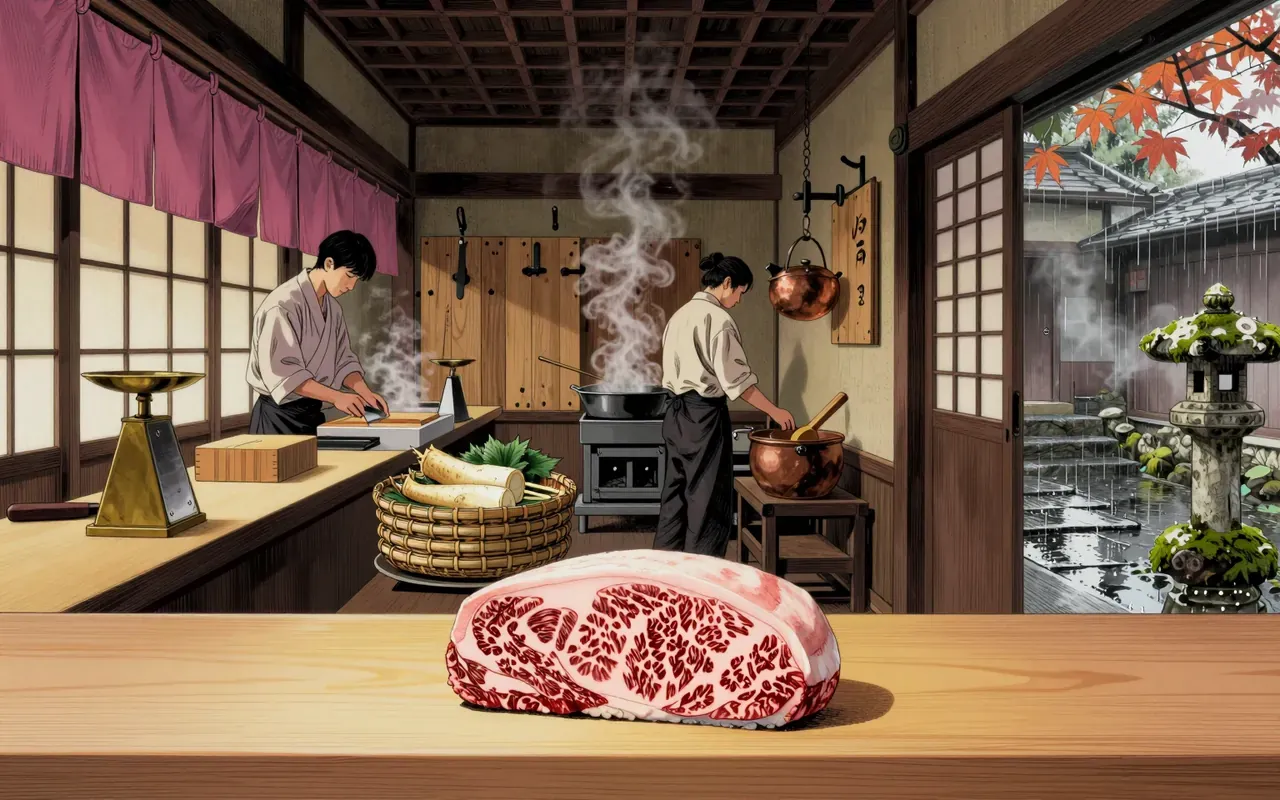
Wagyu isn’t marbled beef—it’s a Japanese cattle registry, and calling anything else Wagyu is linguistic fraud.

Wagyu is a regulated term for four Japanese cattle breeds—not a synonym for marbling or luxury. Its meaning is precise in Japan but diluted abroad. It matters because it reveals how food terms travel faster than their definitions—and how easily origin gets erased in global trade.

Chapters & takeaways4
  1. 0:49
    Not a breed. Four breeds.

    Wagyu names four specific Japanese cattle breeds—not a type of beef or a quality standard.

  2. 2:22
    Made, not found.

    These breeds were built deliberately: native stock crossed with imports, then locked down by closed breeding.

  3. 3:28
    90% is Japanese Black. That’s where sashi lives.

    Japanese Black dominates production and delivers sashi—the real marker of what people call 'Wagyu taste'.

  4. 5:33
    A label with borders.

    Japan’s 2007 rules tie 'Wagyu' to birth, rearing, and documented lineage—in Japan only.

Worth your time?

Yes. Cook the whole thing.

4/ 5
What works
  • culture/food
What does not
  • culture/art
  • culture/arts
  • culture/cities
  • culture/fashion
Cook it if
  • chefs
  • food-policy-watchers
  • importers
Skip it if
  • casual-diners-who-like-marbling
  • restaurant-marketers
The written brief1 min read

What the thing is

Wagyu is a legal and zoological category—not a style of beef. It names four Japanese cattle breeds, not a marbling standard or cooking method.

Where it came from

It emerged from late-nineteenth-century crossbreeding of regional native Japanese cattle—including Mishima and Kuchinoshima—with imported stock, then crystallised as four closed breeds via selective breeding.

What it gets right

It correctly identifies four distinct Japanese cattle breeds developed through documented regional selection and closed breeding. It anchors the term to biological lineage and national rearing—not just taste or texture.

What it gets wrong

It misleads outside Japan by allowing ‘Wagyu’ to label beef from non-Japanese cattle of those breeds—even when raised elsewhere, fed differently, and lacking sashi or aroma. The term is geographically unmoored in export markets.

Why it matters now

Because ‘Wagyu’ is used globally on beef with no Japanese origin, no sashi, and no regulatory oversight—eroding the meaning of terroir, breed integrity, and consumer trust.

Is it worth your time

Yes—if you care about precise language, food labelling, or how global supply chains obscure origin. No—if you assume ‘Wagyu’ guarantees marbling, flavour, or Japanese provenance.
Same course · Dishes4 of 427
9:36
Doubles (food)Doubles is a Trinidadian street food of Indo-Trinidadian origin, created in Princes Town in 1936 by Emamool 'Mamoodeen' Deen and his wife Raheeman Rasulan Deen. It consists of curried chickpeas served on two fried flatbreads called bara. The name 'doubles' came from customers asking to double the bara. It is culturally significant as a symbol of Trinidadian identity, especially among the diaspora, and is credited with defining and maintaining symbolic boundaries of identification in Trinidad's diverse society. Doubles is a comfort food for displaced Trinidadians in major cities across the globe.
12:20
Manchurian (dish)Manchurian is a Mumbai-born Indian-Chinese dish invented in 1975 by Nelson Wang. It uses Indian aromatics (garlic, ginger, green chilli), swaps garam masala for soy sauce, binds with cornstarch, deep-fries, then coats in a soy-based sauce. It delivers crunch, heat and umami—but bears no relation to Manchu or Northeastern Chinese food.
9:38
MuhammaraMuhammara is a red-hued dip originating in Aleppo, Syria, traditionally made with red bell peppers, pomegranate molasses, walnuts, and breadcrumbs, and prepared using a mortar and pestle; it appears in a 1981 encyclopedia and was granted a geographical indication by Turkey in 2022 for Gaziantep.
9:22
Tonkotsu ramenTonkotsu ramen is a pork-bone broth ramen from Kurume, Fukuoka Prefecture, Japan, invented in 1937 by Tokio Miyamoto. Its defining technique is prolonged boiling of pork bones to yield a cloudy, milky broth, and it features culturally distinctive noodle firmness options.
Up next in Food

Whisky

· 7:41

Whisky isn’t born of craft—it’s forged by accident, refined by commerce, and sold as heritage.

7:41