1:23in productionCh. 1 · What the dish is and where it came from/ 1:23 · ceiling 15 min
Baking · Food history
Canelé
A small French pastry from Bordeaux, flavored with rum and vanilla, with a soft interior and dark, thick caramelized crust.
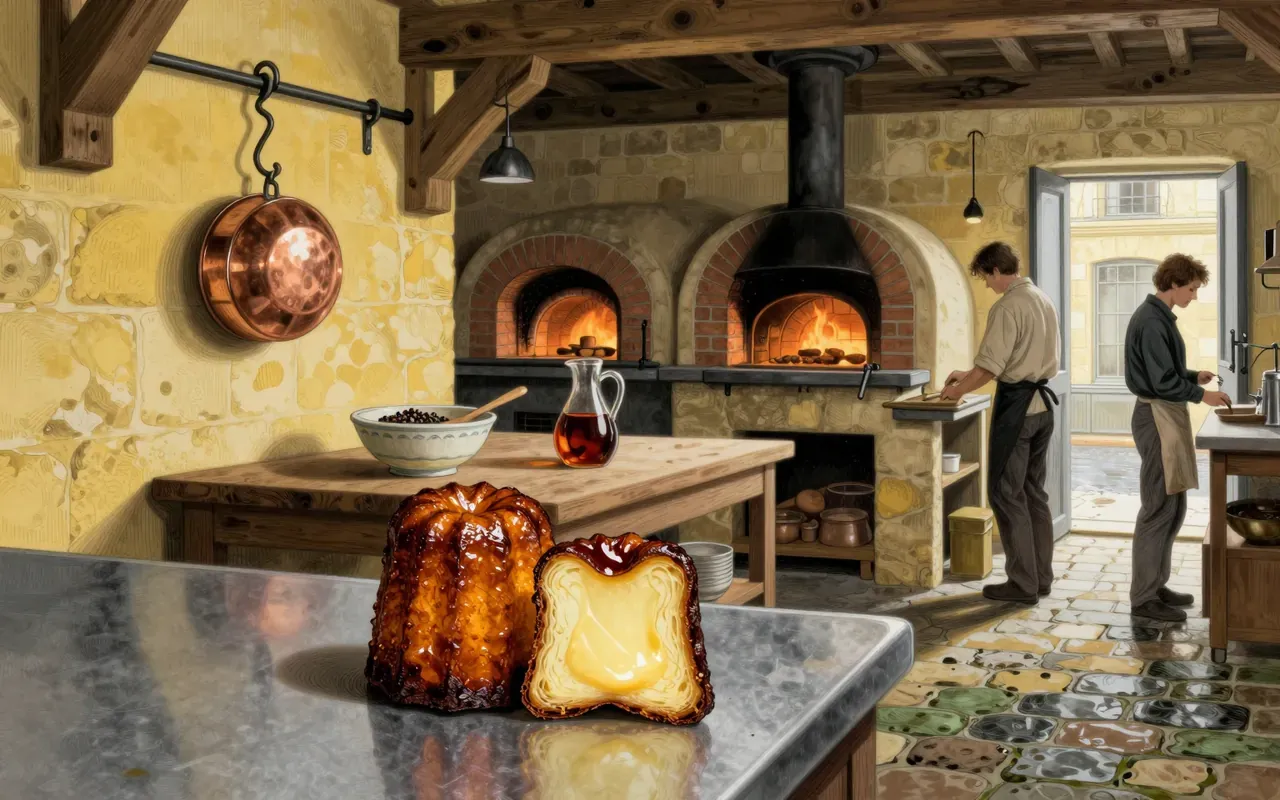
A canelé is a small French pâtisserie from the Bordeaux region of southwestern France. It is flavored with rum and vanilla, has a soft and tender centre, and a dark, thick, caramelized crust. It takes the form of a small, striated cylinder up to five centimetres tall, with a depression at the top. The word 'canelé' originates in Gascon, spoken in Bordeaux until the 19th century. Its origin is attributed to the Couvent des Annonciades in Bordeaux, either in the 15th or 18th century.
A canelé is a small French pâtisserie from the Bordeaux region of southwestern France.
0:34
How it works, in terms someone would actually use
It is traditionally baked in individual fluted copper molds.
0:44
What it gets right
It delivers contrast: a dark, thick, caramelized crust alongside a soft and tender centre.
0:52
What it does not
It is not a savory item; it contains rum and vanilla and is structured as a sweet pâtisserie.
0:59
What it changed
Canauliers—artisans who made canaules—formed a guild in 1663 and later won a legal dispute ending pastry chefs’ monopoly on milk- and sugar-based doughs.
1:08
Who it is for, and who it is not
It is for people seeking a small, rum- and vanilla-flavored pâtisserie with a crisp crust and soft interior.
1:19
Is it worth your time
Yes—it is widely available in pâtisseries in France and abroad.
Worth your time?
Selectively. Start with the brief, then cook the parts we point at.
What works
It delivers contrast: a dark, thick, caramelized crust alongside a soft and tender centre. Rum and vanilla provide distinct flavoring.
What does not
It is not a savory item; it contains rum and vanilla and is structured as a sweet pâtisserie.
Cook it if
Skip it if
The written brief1 min read
What the dish is and where it came from
A canelé is a small French pâtisserie from the Bordeaux region of southwestern France. It is flavored with rum and vanilla, has a soft and tender centre, and a dark, thick, caramelized crust. It takes the form of a small, striated cylinder up to five centimetres tall, with a depression at the top. The word ‘canelé’ originates in Gascon, spoken in Bordeaux until the 19th century. Its origin is attributed to the Couvent des Annonciades in Bordeaux, either in the 15th or 18th century.
How it works, in terms someone would actually use
It is traditionally baked in individual fluted copper molds. These molds are noted for high thermal conductivity, which facilitates immediate thermal shock for uniform surface caramelization.
What it gets right
It delivers contrast: a dark, thick, caramelized crust alongside a soft and tender centre. Rum and vanilla provide distinct flavoring.
What it does not
It is not a savory item; it contains rum and vanilla and is structured as a sweet pâtisserie.
What it changed
Canauliers—artisans who made canaules—formed a guild in 1663 and later won a legal dispute ending pastry chefs’ monopoly on milk- and sugar-based doughs.
Who it is for, and who it is not
It is for people seeking a small, rum- and vanilla-flavored pâtisserie with a crisp crust and soft interior. It is not for those avoiding alcohol or dairy-based sweets.
Is it worth your time
Yes—it is widely available in pâtisseries in France and abroad.
A regional Vietnamese noodle dish from Hội An, featuring chewy lye-treated rice noodles, marinated pork, fresh herbs, bean sprouts, lettuce, and crispy noodle squares.