foodbriefs
10:50in productionCh. 1 · Naval origins/ 10:50 · ceiling 15 min
Dishes · Food history

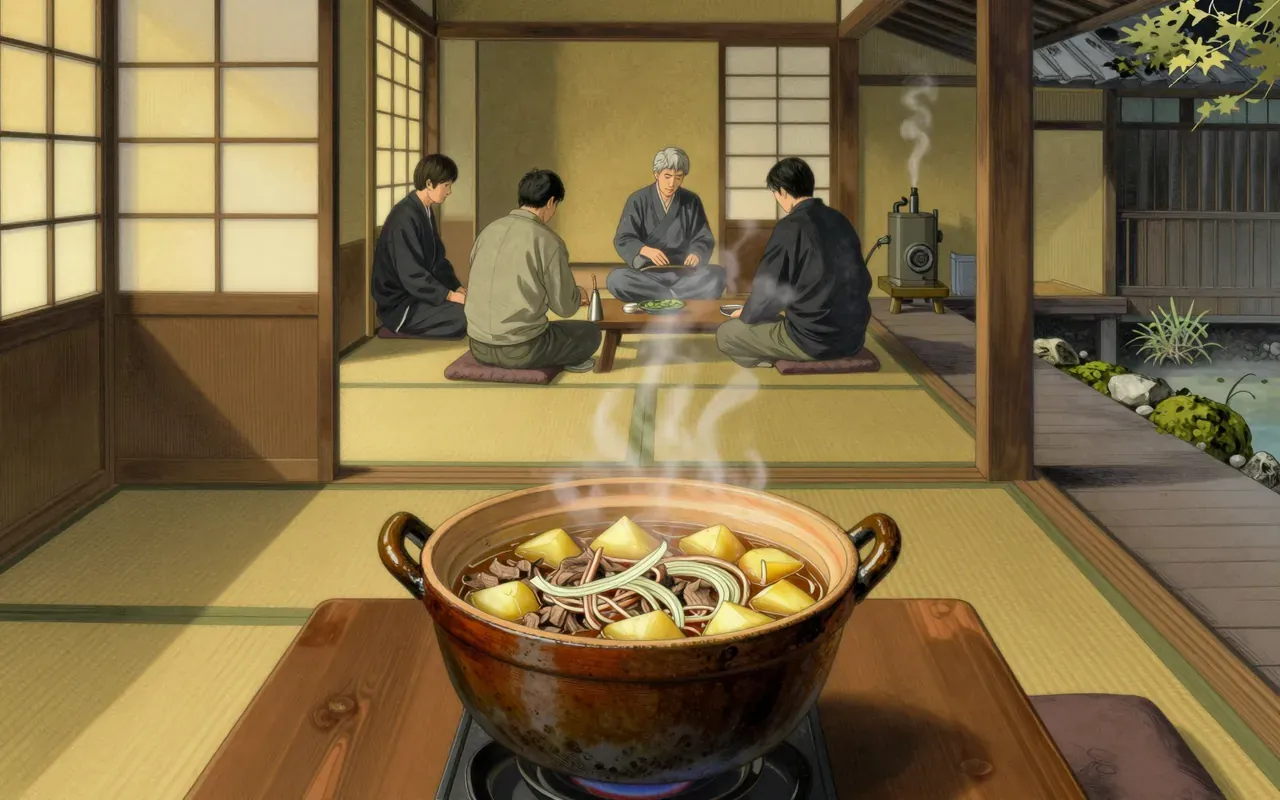
Nikujaga

A naval adaptation of British beef stew—stripped of its fat, fortified with dashi, and made to feed sailors on rice.

Nikujaga is a Japanese stew of beef, potatoes, and onions simmered in dashi, soy sauce, mirin, and sugar. It was invented by Imperial Japanese Navy chefs in the late 19th century as a Japanese adaptation of British Royal Navy beef stew. Competing claims locate its origin in Maizuru, Kyoto and Kure, Hiroshima—both tied to Tōgō Heihachirō’s naval service.

Chapters & takeaways4
  1. 1:06
    Naval origins

    Nikujaga was invented by Imperial Japanese Navy chefs—not home cooks, not restaurateurs, but military cooks solving a logistical problem.

  2. 2:46
    British blueprint

    It is a direct adaptation of British Royal Navy beef stew, not an evolution of older Japanese stews.

  3. 4:48
    Two ports, one order

    Maizuru and Kure both claim nikujaga—but only because Tōgō Heihachirō served in both places and ordered the dish in both.

  4. 6:40
    Pantry swap

    The British original used stock, flour, and root vegetables; nikujaga substituted dashi, mirin, and potatoes—changing the dish’s structure, not just its seasoning.

Worth your time?

Yes. Cook the whole thing.

4/ 5
What works
  • It balances salt, sweetness, and umami in one pot.
  • The potatoes absorb flavour without disintegrating.
  • The beef stays tender without overcooking.
  • Dashi gives it a clean, oceanic backbone.
What does not
  • It does not replicate British beef stew’s richness or long braise.
  • It lacks dairy, wine, or herbs.
  • It does not rely on reduction or searing for complexity.
Cook it if
  • It is for cooks who want a weeknight dish with layered flavour and zero ambiguity.
  • It is not for those seeking acidity, heat, texture contrast, or fermentation.
Skip it if
  • It is not for those seeking acidity, heat, texture contrast, or fermentation.
The written brief1 min read

What the dish is and where it came from

Nikujaga is a Japanese stew of beef, potatoes, and onions simmered in dashi, soy sauce, mirin, and sugar. It was invented by Imperial Japanese Navy chefs in the late 19th century.

How it works, in terms someone would actually use

Simmer thin slices of beef, waxy potatoes, and onions in dashi, soy sauce, mirin, and sugar until the potatoes hold their shape but yield to gentle pressure.

What it gets right

It balances salt, sweetness, and umami in one pot. The potatoes absorb flavour without disintegrating. The beef stays tender without overcooking. Dashi gives it a clean, oceanic backbone.

What it does not

It does not replicate British beef stew’s richness or long braise. It lacks dairy, wine, or herbs. It does not rely on reduction or searing for complexity.

What it changed

It replaced British Royal Navy beef stew with a Japanese pantry: dashi for stock, mirin for sweetness, soy for umami, and potatoes as starch instead of root vegetables or flour-thickened gravy.

Who it is for, and who it is not

It is for cooks who want a weeknight dish with layered flavour and zero ambiguity. It is not for those seeking acidity, heat, texture contrast, or fermentation.

Is it worth your time

Yes—if you want a dish that delivers savoury-sweet depth with minimal technique and clear regional logic.

Same course · Dishes4 of 485
Up next in Food

Nouvelle cuisine

1960 · 9:04

Nouvelle cuisine wasn’t a menu — it was a manifesto written by critics, served on smaller plates.

9:04